

Understanding the different types of HVAC systems is one of those topics that separates architects who can coordinate with engineers from architects who just nod along in meetings. Whether you’re studying for the ARE (especially PPD) or just trying to make smarter decisions on real projects, knowing which mechanical system fits which building type is a skill you’ll use for the rest of your career. In this post, we’re breaking down every major HVAC system type, organized into four clear categories, and then matching each one to the building types where it actually makes sense.
This podcast is also available on YouTube, Spotify, and Apple Podcasts
Why HVAC System Selection Matters
Let’s get something out of the way first. Architects don’t design HVAC systems. That’s the mechanical engineer’s job. But here’s the thing.
The HVAC system your engineer selects has a massive impact on your building design.
It affects floor-to-floor heights, ceiling plenum depths, mechanical room sizes, shaft locations, and even how the building envelope performs. If you don’t understand the basics of how these systems work, you’re going to have a hard time coordinating your design with the rest of the team.
On the ARE, particularly the Project Planning and Design (PPD) exam, you’re expected to know which system fits which building type and why.
Nobody’s asking you to calculate duct sizes or refrigerant charges. They want to know if you can look at a project and understand which HVAC approach makes sense given the building’s use, size, and constraints. That’s exactly what we’re covering here:
Four categories of HVAC systems, the specific system types within each category, and how to match them to real buildings.
If you want to go even deeper into how each system works with video lessons and practice questions, Mechanical Systems 101 covers all of it for the PPD and PDD exams.
What Are the Types of HVAC Systems?
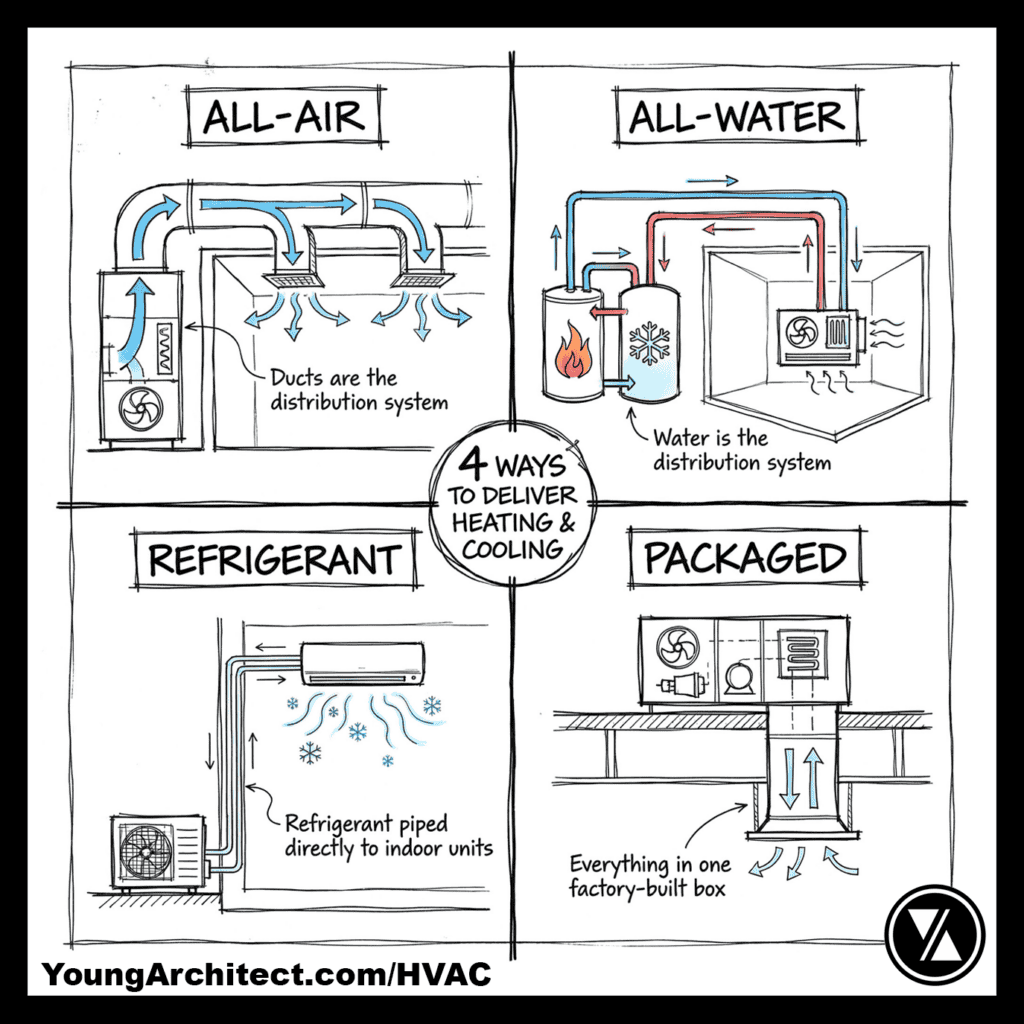
Every HVAC system you’ll encounter falls into one of four categories based on how it delivers heating and cooling to the occupied spaces:
- All-Air Systems – Conditioned air delivered through ductwork. The ducts ARE the distribution system.
- Water-Based Systems (Hydronic) – Hot or chilled water piped to terminal units in the space. The water IS the distribution system.
- Refrigerant-Based Systems – Refrigerant piped directly to indoor units. No water loop to occupied spaces, no large ductwork for distribution.
- Packaged and Unitary Systems – Self-contained units with everything in one box. Factory-assembled and ready to go.
Think of it like structural systems. You’ve got steel, concrete, wood, and masonry. Each one has subtypes, each one has strengths and limitations, and the building dictates the choice. HVAC works the same way.
For the full technical reference on how these systems are classified and specified, ASHRAE’s HVAC Systems and Equipment Handbook is the industry standard.
Now let’s break down each category and the specific systems inside them.
All-Air HVAC Systems
All-air systems do exactly what the name says.
They use air as the sole medium for delivering heating and cooling to the occupied spaces. A central air handling unit (AHU) conditions the air, and ductwork distributes it throughout the building.
These systems require the most distribution space of any category. You’re looking at large ceiling plenums for horizontal duct runs, sizable mechanical shafts for vertical risers, and dedicated mechanical rooms for the air handling equipment.
That translates directly to higher floor-to-floor heights and bigger cores, which is something you’ll feel in every section you draw.
Single-Zone Systems (CAV)
This is the simplest type of all-air system.
One air handling unit serves one zone at one temperature. The air volume stays constant (that’s why it’s called Constant Air Volume, or CAV), and the system either heats or cools the entire space uniformly.
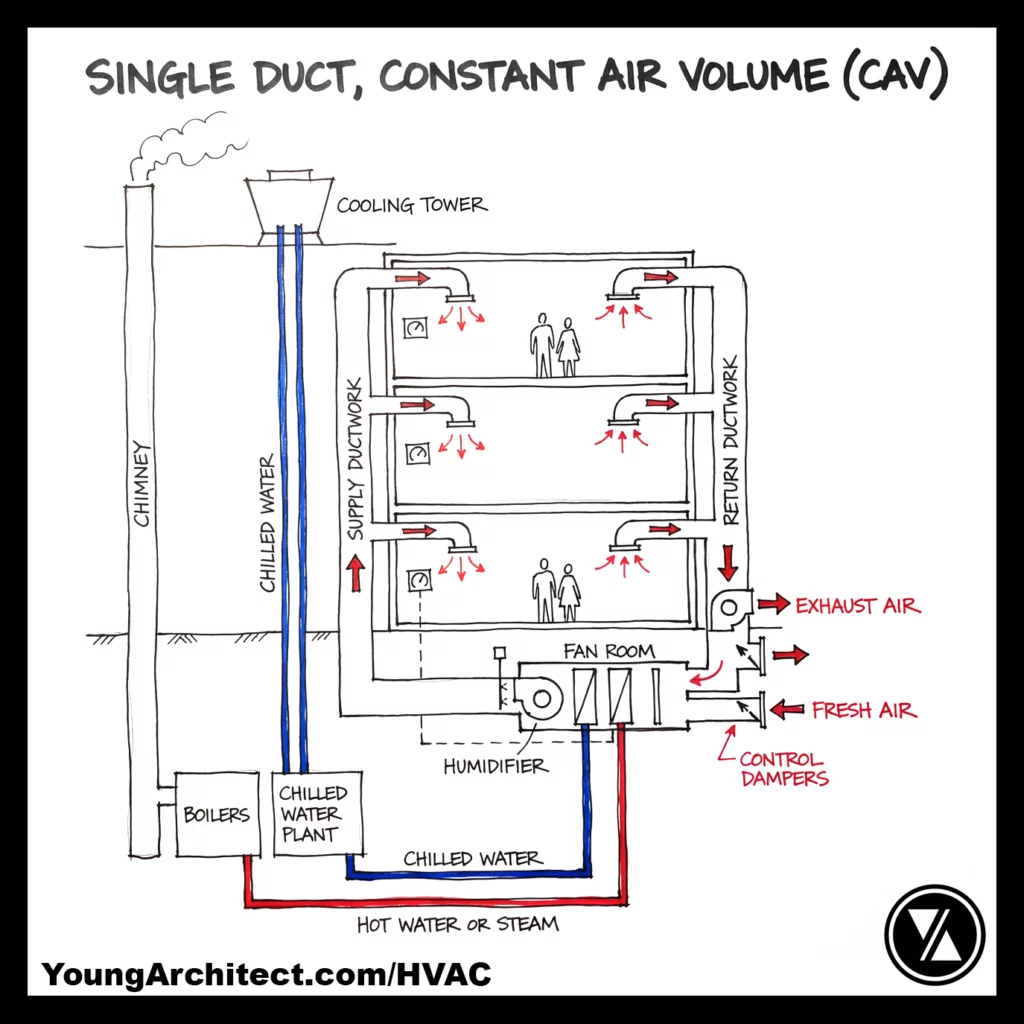
Single-zone systems work best for large, open spaces that have one consistent thermal load.
Think gymnasiums, auditoriums, warehouses, and big box retail stores.
One big space, one temperature, one system. Simple.
The tradeoff?
Zero flexibility.
If one side of the gym is getting afternoon sun and the other side is in shade, too bad. The whole space gets the same air at the same temperature.
That’s why single-zone systems don’t work for buildings with multiple rooms or zones that have different heating and cooling needs.
Multi-Zone and VAV Systems
When a building has multiple zones that each need different temperatures (which is most buildings), you need a Variable Air Volume (VAV) system.
A VAV system uses a central AHU just like a single-zone system, but instead of blasting the same amount of air everywhere, it uses VAV terminal boxes at each zone.
These boxes modulate the airflow up or down based on what that specific zone needs. When a conference room full of people needs more cooling, the VAV box opens up. When the room empties out, it throttles back.
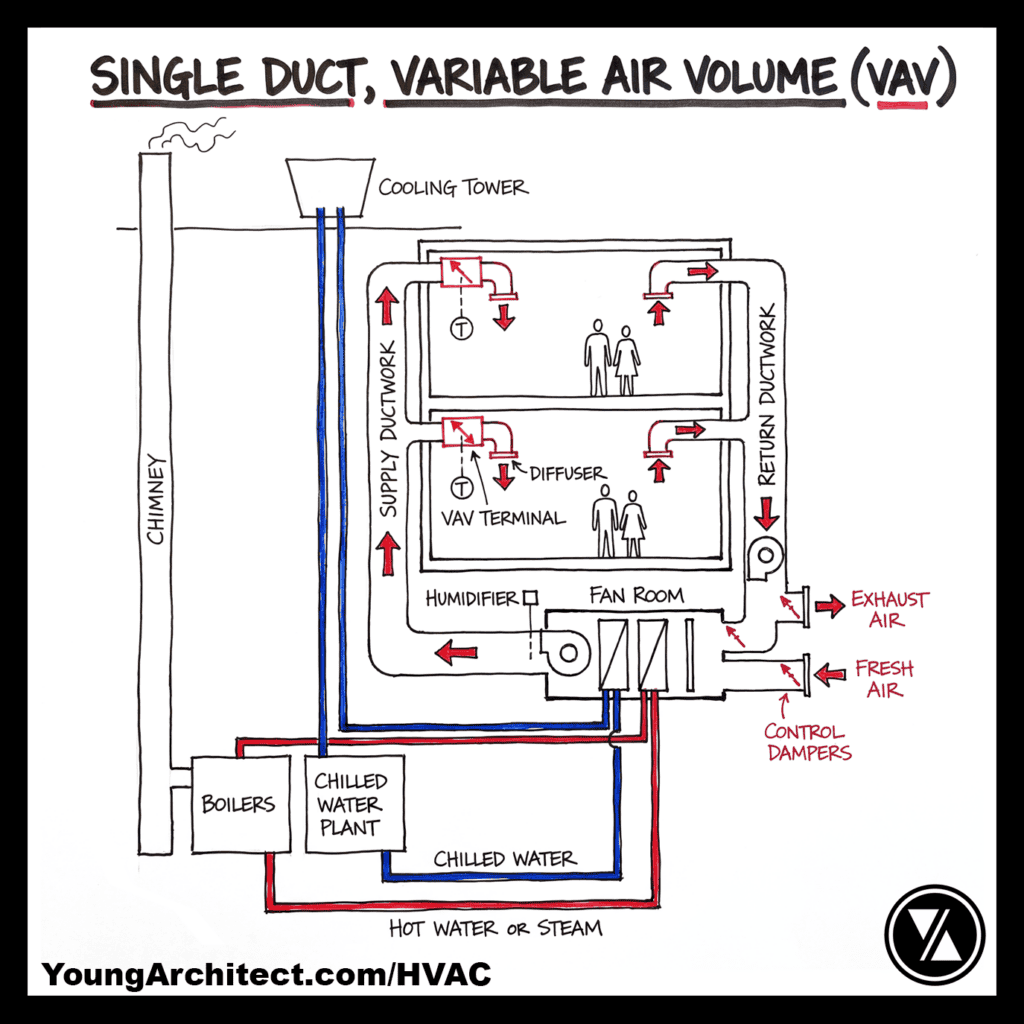
Many VAV systems also include reheat coils at the terminal boxes. Here’s the logic:
The central AHU cools and dehumidifies all the air for the entire building, which is what the core zones and sun-loaded perimeter zones need.
But if a north-facing office in winter is already cold, you don’t want to dump cool air into it. The reheat coil at that zone’s VAV box warms the air back up before it enters the room.
It sounds wasteful (and it is a little bit), but it gives you precise temperature control in every zone without needing separate heating and cooling distribution.
VAV is the workhorse of commercial HVAC. If you walk into a large office building, a hospital, a university building, or a school, there’s a very good chance it’s running on a VAV system. It’s the most common system type for buildings with multiple zones, and it’s the one you’ll see referenced most often on the ARE.
One more thing worth knowing: VAV ductwork is the most common source of structural coordination conflicts in the ceiling plenum. Large supply and return ducts competing for space with beams, sprinkler mains, and conduit is a classic PDD coordination scenario. If an exam question asks about ceiling plenum conflicts, think VAV first.
Dedicated Outdoor Air Systems (DOAS)
A DOAS is a little different from the other all-air systems because it doesn’t handle heating and cooling on its own.
Instead, it handles ventilation, meaning it’s responsible for bringing in fresh outdoor air, filtering it, and conditioning it to a neutral state before delivering it to the building.
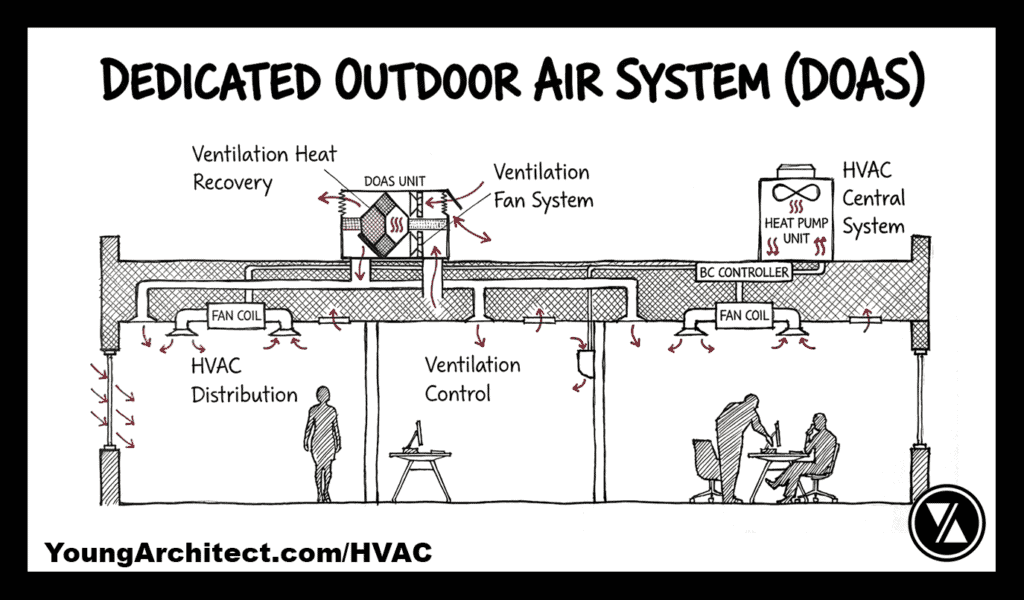
The actual heating and cooling of the spaces?
That gets handled by a separate system entirely, like VRF, fan coils, or radiant panels. The DOAS just takes care of the fresh air side of the equation.
While it technically uses air as its delivery medium, think of it as a supplemental ventilation system rather than a primary heating and cooling system.
It’s the sidekick to your hydronic or VRF system, not the hero.
Why separate them?
Because it’s more energy efficient. Instead of one giant system trying to do everything, you’ve got a dedicated system optimized for ventilation and another system optimized for thermal comfort.
DOAS is becoming increasingly popular in high-performance buildings, and you’ll often see it paired with VRF or radiant systems.
Ventilation rates for commercial buildings are governed by ASHRAE Standard 62.1, which is a big reason why DOAS has become so important in modern building design.
If you see DOAS mentioned on the ARE, the key thing to remember is that it’s always paired with something else. It never works alone.
Water-Based HVAC Systems (Hydronic Systems)
Hydronic systems use water as the primary medium for transporting heating and cooling energy throughout the building.
Instead of large ductwork, you’ve got pipes. And instead of air blowing out of diffusers, you’ve got terminal units in the occupied spaces that use the hot or chilled water to condition the air locally.
The big advantage from an architect standpoint?
Pipes are dramatically smaller than ducts.
Water is a far more efficient medium for carrying thermal energy than air, so hydronic systems require significantly less shaft space and much shallower ceiling plenums for distribution.
You’ll still need some plenum space for a small DOAS or ventilation ductwork (since hydronic systems only move water, not air), but it’s a fraction of what an all-air system demands.
Fan Coil Units (FCUs)
A fan coil unit is a small, simple device in each room or zone. It has a fan and a coil (hence the name). Hot or chilled water gets piped to the coil, the fan blows room air across it, and conditioned air comes out the other side.
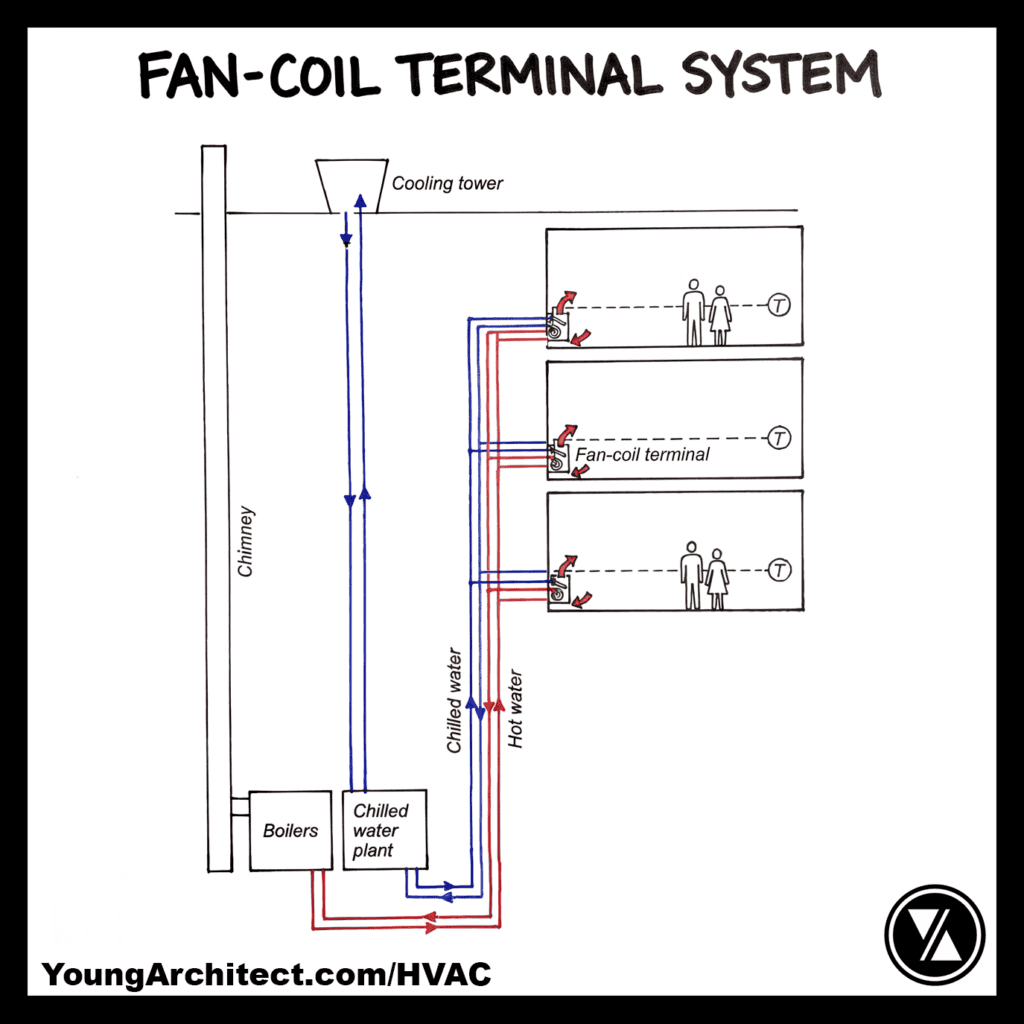
Fan coils come in two main configurations:
- Two-pipe systems – One supply pipe and one return pipe. The building is either in heating mode or cooling mode, but not both at the same time. The whole building switches seasonally.
- Four-pipe systems – Separate hot water and chilled water piping to each unit. Every room can independently heat or cool at any time. More expensive to install, but way more flexible.
Fan coil units are the go-to system for buildings with lots of individual rooms that each need their own temperature control.
Hotels, apartments, condos, dormitories, assisted living facilities.
Anywhere you’ve got a hallway full of rooms and every occupant wants to set their own thermostat.
For the ARE, remember this: if the question describes a building with many individually controlled rooms and mentions a hydronic system, fan coils are almost certainly the answer.
Chilled Beams
Chilled beams are ceiling-mounted units that use chilled water to cool the space through convection. Cool water flows through the beam, the air around it cools and drops, and warm air rises to replace it.
It’s a simple, quiet, and energy-efficient approach to cooling.
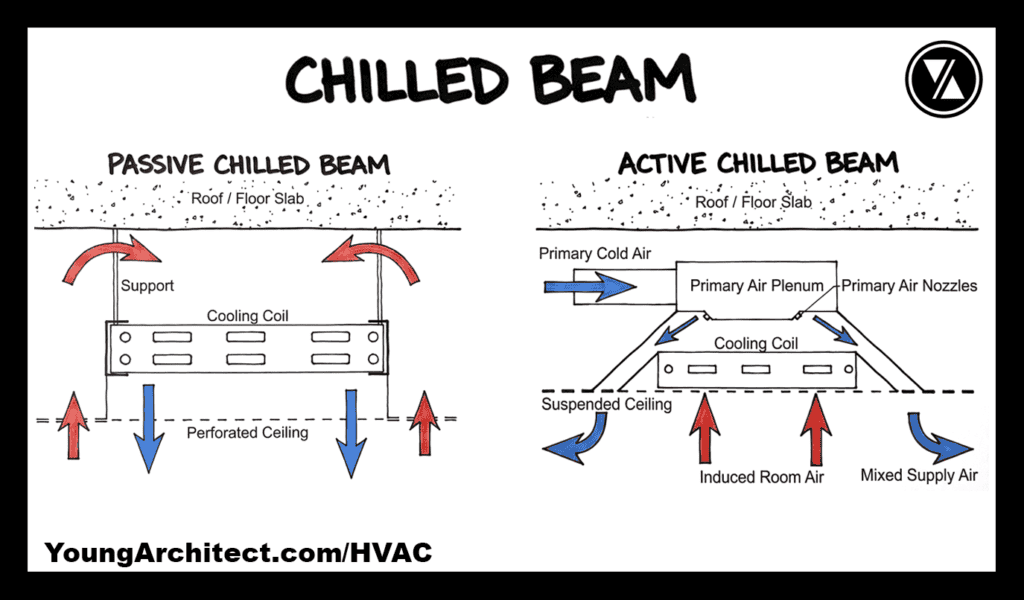
There are two types:
- Passive chilled beams – Rely entirely on natural convection. No fan, no moving parts. Very quiet but limited cooling capacity.
- Active chilled beams – Use a small amount of primary air (usually from a DOAS) to induce more room air across the coil, boosting capacity significantly.
The critical thing to know about chilled beams is humidity control.
If the beam surface gets below the dew point of the room air, you get condensation dripping from the ceiling. That’s a disaster.
So chilled beam installations require very tight humidity control, which is why they’re often paired with a DOAS that dehumidifies the incoming air before it enters the space.
Chilled beams show up most often in labs, offices, and hospitals where quiet operation and energy efficiency matter.
And speaking of quiet operation, if you want to understand how sound performance plays into building system decisions, our post on building acoustics covers STC, IIC, and NRC ratings in detail.
Radiant Heating and Cooling
Radiant systems embed piping directly into building surfaces like floors, walls, or ceilings.
Hot or chilled water circulates through the pipes, and the surface itself becomes the heating or cooling element.
Instead of blowing conditioned air at you, the system radiates thermal energy directly to the occupants and objects in the space.
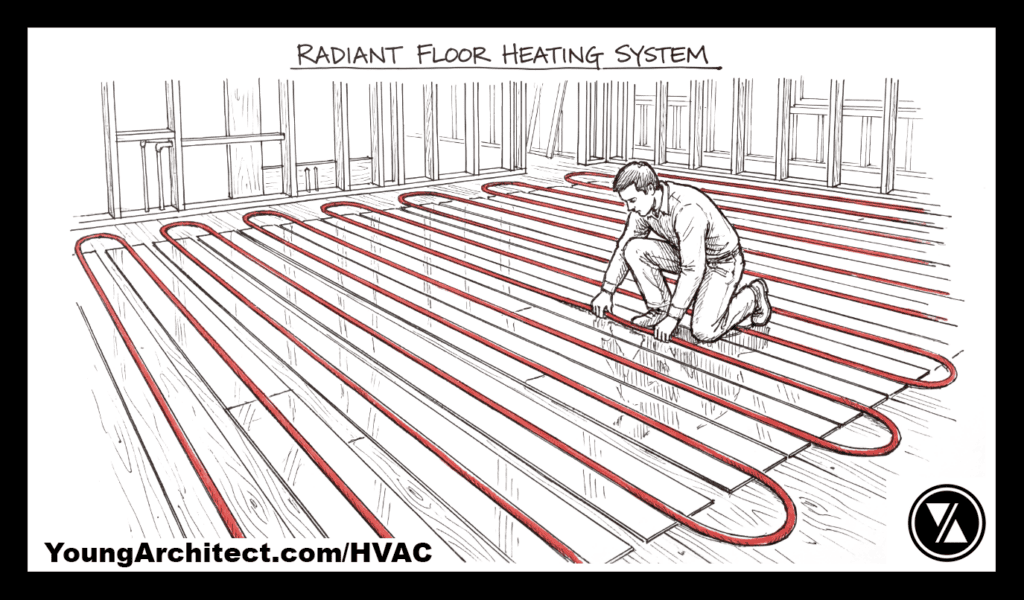
The key distinction is the mode of heat transfer. Forced-air systems use convection (moving air).
Radiant systems use radiation (direct energy transfer between surfaces). It’s the difference between standing next to a campfire and standing in front of a fan.
The campfire warms you even if the air is cold. That’s radiant heat.
A few important rules:
- Radiant floors are best for heating. Heat rises, so warming the floor makes sense.
- Radiant ceilings are best for cooling. Cool air drops, so cooling from above works with natural convection.
- Radiant systems MUST be paired with a ventilation system (usually DOAS) because they move zero air. No air movement means no fresh air delivery on their own.
Radiant floor heating is popular in high-end residential projects, airport terminals, large lobbies, and spaces with high ceilings where forced air would be impractical.
Imagine trying to heat an airport terminal with ceiling-mounted diffusers 40 feet up.
The air would never reach the people. Radiant floors solve that problem by heating the surface people are actually standing on.
Refrigerant-Based Systems
Refrigerant-based systems pipe refrigerant directly from outdoor units to indoor units in the occupied spaces.
The refrigerant itself carries the heating and cooling energy, and the heat exchange happens right at the indoor unit.
The piping is small (much smaller than hydronic piping and dramatically smaller than ductwork), which means refrigerant-based systems need almost no shaft space and zero ceiling plenum for distribution.
That makes them attractive for buildings where space is tight, floor-to-floor heights are limited, or where running extensive ductwork isn’t practical.
You’ll still need a small DOAS for ventilation, but the distribution infrastructure for the thermal system itself is minimal.
VRF/VRV Systems
If there’s one HVAC system type that’s been gaining ground faster than any other, it’s Variable Refrigerant Flow (VRF). You might also see it called VRV (Variable Refrigerant Volume), which is Daikin’s proprietary name for the same technology.
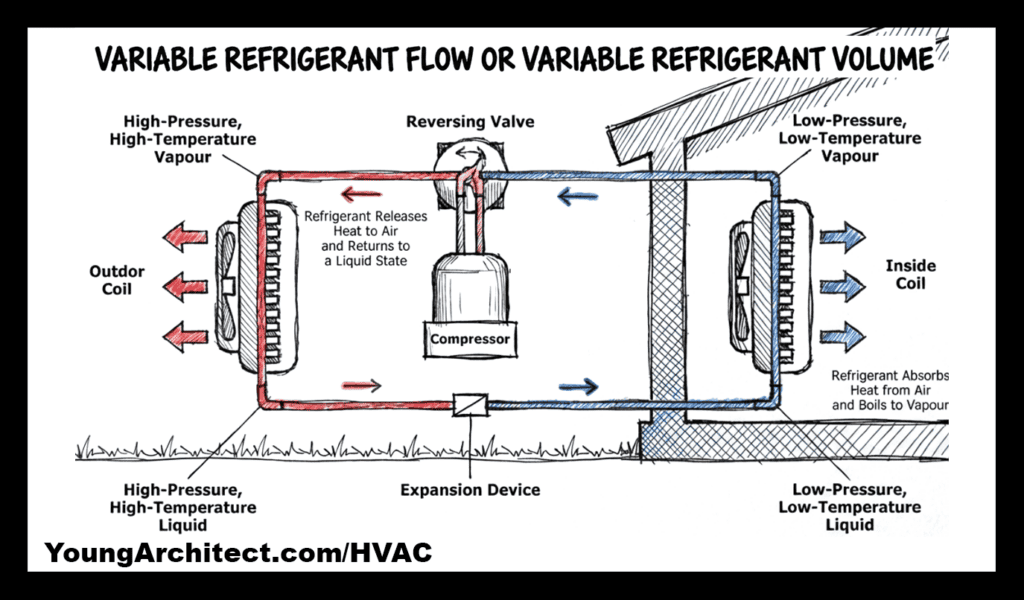
Here’s how it works. One or more outdoor condensing units connect to multiple indoor units throughout the building via small refrigerant piping.
Each indoor unit can independently heat or cool its zone. And with heat recovery VRF systems, the system can actually heat one zone while simultaneously cooling another by redistributing the refrigerant.
Think about a building on a sunny spring day. The south-facing offices are baking and need cooling. The north-facing offices are chilly and need heating.
A heat recovery VRF system handles both at the same time by moving heat from where it’s not wanted to where it is. That’s incredibly efficient.
VRF is popular for mid-rise office buildings, hotels, retrofits, and mixed-use buildings.
It’s especially attractive for renovations because the small refrigerant piping is much easier to route through existing buildings than bulky ductwork.
A few limitations to know:
- Some building codes limit the total refrigerant charge allowed in occupied spaces, which can restrict VRF in certain building types
- VRF requires specialized service technicians, not every HVAC contractor can work on these systems
- Like all refrigerant-based systems, VRF still needs a separate ventilation source for fresh air (often a DOAS)
For the ARE, VRF is showing up more and more. Know what it is, know what buildings it works for, and know that it needs ventilation paired with it.
Split Systems
The split system is what most people picture when they think of residential HVAC. An outdoor condenser unit sits outside the house, connected by refrigerant lines to an indoor air handler or furnace.
The indoor unit connects to ductwork that distributes conditioned air throughout the house.
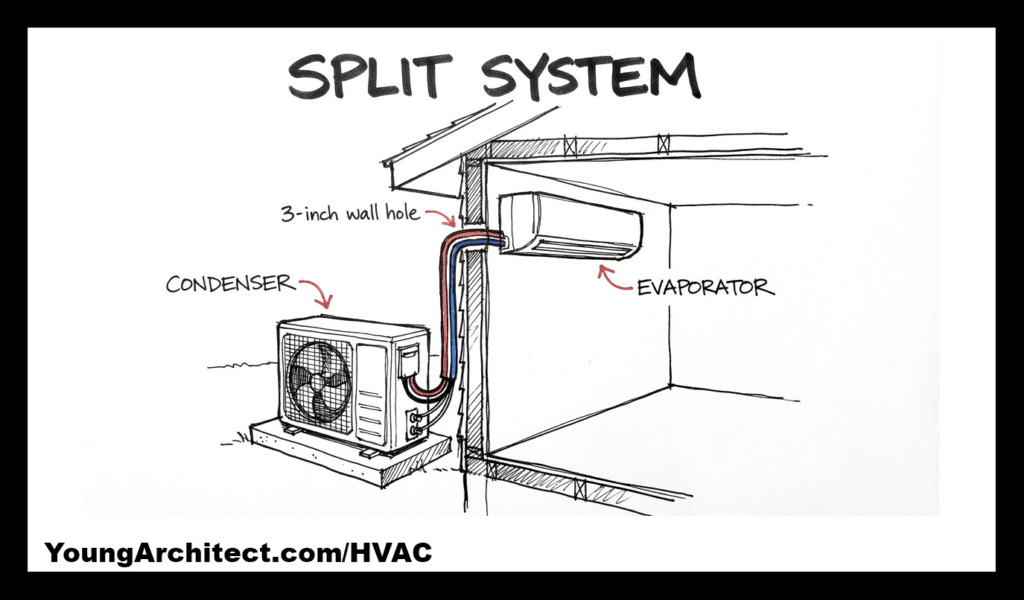
The name says it all: the system is split into two pieces, one inside and one outside, connected by refrigerant piping.
This makes it a refrigerant-based system at its core, even though it uses ductwork inside the building to distribute the air. The refrigerant is what moves the energy between the outdoor and indoor units.
Split systems are the standard for single-family homes and small commercial buildings. They’ve been around forever, every HVAC contractor knows how to install and service them, and parts are widely available.
Mini-Split and Multi-Split Systems
Mini-split systems work on the same principle as traditional split systems (refrigerant piped between an outdoor and indoor unit), but they ditch the ductwork entirely. One outdoor unit connects to one indoor unit through a small refrigerant line. That’s it. No ducts, no complex piping networks.
Multi-split systems expand on this by connecting one outdoor unit to several indoor units (typically two to five). Each indoor unit can be controlled independently, giving you zone-by-zone temperature control without any ductwork.
Mini-splits and multi-splits are the go-to solution for residential additions, small commercial spaces, server rooms, retrofits, and supplemental cooling in spaces where extending the existing HVAC system isn’t practical. They’re affordable, efficient, and relatively easy to install.
The difference between a mini-split and a VRF system is mostly scale. Mini-splits and multi-splits serve a handful of zones. VRF serves an entire building. The underlying technology (refrigerant piped to indoor units) is fundamentally the same.
Ground-Source Heat Pumps (Geothermal)
Ground-source heat pumps are technically a hybrid: they use a refrigerant cycle inside the building, but they rely on a hydronic (water) loop outside the building to exchange heat with the earth. That’s what makes them so efficient. Instead of exchanging heat with the outdoor air (like a conventional heat pump), the ground loop circulates water mixed with antifreeze through buried piping to take advantage of the earth’s stable underground temperature, typically around 50-60°F depending on your location.
In winter, the ground is warmer than the air, so the system extracts heat from the ground and delivers it to the building. In summer, the ground is cooler than the air, so the system dumps heat into the ground. The ground temperature is so stable compared to outdoor air that the system runs far more efficiently than an air-source heat pump in extreme weather.
Ground loops can be horizontal (trenches dug a few feet below grade, requiring a lot of land area) or vertical (boreholes drilled deep into the ground, requiring less surface area but higher drilling costs).
Ground-source systems are best for campuses, institutional buildings, and projects with long-term ownership where the higher upfront installation cost gets paid back over decades of lower operating costs. They’re not as commonly tested on the ARE as VAV or VRF, but they’re worth knowing, especially for questions about energy-efficient system selection and sustainable design strategies.
Packaged and Unitary Systems
Packaged systems take a different approach from everything we’ve discussed so far. Instead of separating the components across a building, packaged systems put everything in one self-contained box. Compressor, condenser, evaporator, fans, filters, all factory-assembled and ready to install.
The appeal is simplicity.
Lower first cost, easier installation, straightforward maintenance. The tradeoff is that packaged systems generally offer less flexibility and efficiency than the more sophisticated systems we’ve already covered.
From an architectural standpoint, packaged systems keep most or all of the equipment outside the building envelope, which simplifies your interior layout but means you need roof structure or exterior space to support the units.
Rooftop Units (RTUs)
Rooftop units are exactly what they sound like.
Self-contained HVAC units that sit on the roof.
They pull in outdoor air, condition it, and push it down into the building through ductwork. All the mechanical equipment stays outside, which means no interior mechanical room is needed.
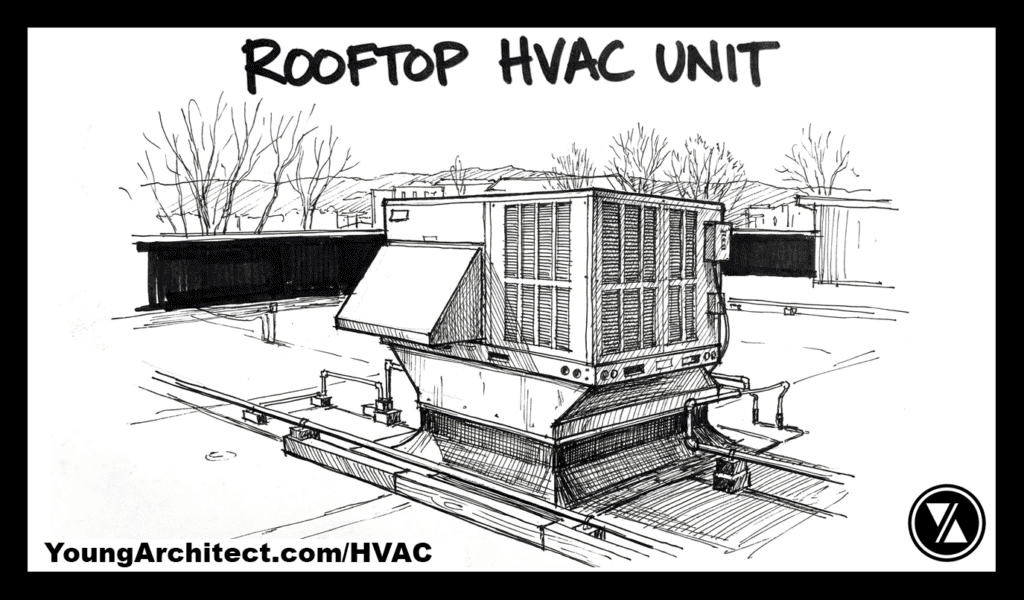
RTUs are arguably the most common HVAC system in America.
Drive past any strip mall, fast food restaurant, small retail store, or single-story commercial building and look up at the roof. Those big metal boxes? Rooftop units.
They’re popular because they’re simple, relatively affordable, and easy to service. When one fails, a technician goes up to the roof, works on it (or swaps it out), and the interior of the building is barely affected.
For single-story commercial buildings, it’s hard to beat the practicality of an RTU.
PTACs and PTHPs
You know that unit under the window in almost every hotel room? The one that sounds like a jet engine at 2 AM? That’s a PTAC.
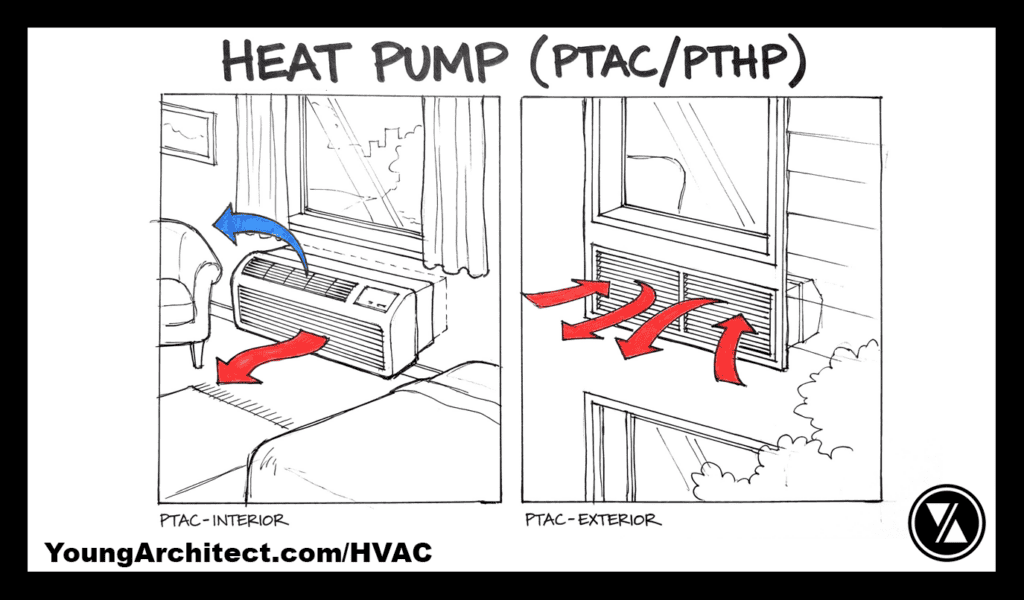
A PTAC (Packaged Terminal Air Conditioner) is a self-contained, through-wall unit that handles heating and cooling for a single room.
It pulls air from the room, conditions it, and pushes it back out. The back half of the unit sticks through the exterior wall to reject heat (or absorb it in heating mode).
You’ll also see PTHPs (Packaged Terminal Heat Pumps), which work the same way but use a heat pump cycle instead of electric resistance heating.
PTHPs are more energy efficient in heating mode, which makes them a better choice in climates where both heating and cooling are needed. Same form factor, same wall sleeve, just a smarter heating approach.
PTACs and PTHPs are the lowest-cost option for individual room control.
Hotels, motels, assisted living facilities, and small apartment buildings use them because they’re cheap to buy, cheap to install, and easy to replace.
When one dies, you pull it out of the wall sleeve and slap in a new one.
The downsides are noise, efficiency, and aesthetics. PTACs are louder than fan coils or VRF units, they’re less energy efficient than centralized systems, and they take up wall space under the window in every room.
That’s why higher-end hotels tend to use fan coils or VRF instead.
Matching HVAC Systems to Building Types
This is where everything comes together, and this is what the ARE is really testing you on. It’s not about memorizing equipment specs. It’s about looking at a building and understanding which HVAC system makes sense and why.
The key factors that drive system selection are building use, the number of zones that need independent control, ventilation requirements, available space for equipment and distribution, and budget.
When you understand those variables, the right system usually becomes obvious.
According to the U.S. Department of Energy’s analysis of commercial building HVAC energy consumption, HVAC accounts for roughly 40% of commercial building energy use, which is why system selection has such a significant impact on operating costs.
Here’s a quick-reference guide:
| Building Type | Primary System(s) | Why It Works |
|---|---|---|
| Large Office Buildings | VAV with reheat | Multiple zones, centralized control, efficient at scale |
| Mid-Rise Offices | VRF or fan coils | Flexible zoning, smaller mechanical rooms |
| Hotels | Fan coils (4-pipe), PTACs, VRF | Individual room control is non-negotiable |
| Hospitals | VAV + DOAS | Strict ventilation, pressure relationships, infection control |
| Schools (K-12) | VAV or RTUs, DOAS gaining ground | Budget-friendly, varying room sizes |
| Multifamily Residential | Fan coils, VRF, mini-splits, PTACs | Individual unit control, tenant metering |
| Retail (single-story) | Rooftop units | Simple, cost-effective, easy maintenance |
| Retail (large/department) | VAV | Multiple departments, centralized plant |
| Warehouses/Industrial | Single-zone CAV, unit heaters, radiant heaters | Large open volumes, minimal zoning |
| Labs | VAV with 100% OA, chilled beams | High air change rates, exhaust requirements |
| Airports/Large Lobbies | Radiant + DOAS | High ceilings, large volumes, occupant comfort at floor level |
| Single-Family Residential | Split systems, mini-splits | Proven, affordable, widely available |
A couple of important notes on this table.
First, these aren’t rigid rules.
Plenty of buildings use hybrid or combination systems. A hospital might use VAV for general areas, fan coils in patient rooms, and radiant in the lobby. Real buildings are messier than exam questions.
Second, the pattern you should notice is that the building’s use drives the system selection.
Buildings with many individual rooms need individual control (fan coils, VRF, PTACs). Buildings with large open spaces need simple, centralized systems (CAV, RTUs). Buildings with strict ventilation requirements need systems that prioritize air quality (VAV with DOAS).
The building’s occupancy classification and construction type will also influence system selection, since fire-resistance requirements and allowable building heights affect where equipment can go and how distribution systems are routed.
How HVAC Zoning Works
One concept that ties all of these systems together is zoning. An HVAC zone is any area of a building that’s controlled by its own thermostat or temperature sensor. How a building gets divided into zones, and how many zones it needs, is one of the biggest factors in choosing the right system.
A single-zone system (like a CAV or a basic RTU) treats the entire served area as one zone. One thermostat, one temperature. This works for spaces where the thermal load is uniform, like a warehouse or a gymnasium.
A multi-zone system divides the building into separate zones that can each be controlled independently. VAV systems do this with terminal boxes. Fan coil units do this with individual units in each room. VRF does this with individual indoor units connected to a shared outdoor unit. The method is different, but the goal is the same: give different spaces different temperatures based on their actual needs.
The more zones a building needs, the more sophisticated (and expensive) the HVAC zoning system becomes. A 200-room hotel needs 200 zones. A small retail store might need one. That’s why a hotel uses fan coils or VRF while a retail store uses a rooftop unit. The zoning requirement drives the system selection.
When you’re looking at an ARE question about system selection, ask yourself: how many zones does this building need? That single question will eliminate most of the wrong answers immediately.
How These Systems Show Up on the ARE
The PPD and PDD exams are where HVAC system knowledge gets tested most heavily. But it shows up differently than you might expect.
The ARE doesn’t ask you to design an HVAC system. It doesn’t ask you to size equipment or calculate loads.
What it does ask is whether you understand how HVAC systems integrate with your building design.
And while both exams cover mechanical systems, they come at it from different angles: PPD asks you to choose the right system based on the building program and constraints, while PDD asks you to coordinate that system with structural, electrical, and plumbing components in the ceiling plenum and mechanical room. That means questions like:
- Which system is most appropriate for this building type?
- What spatial requirements does this system need (mechanical rooms, shafts, ceiling plenums)?
- How does this system affect the building’s energy performance?
- What other systems need to be paired with it (like DOAS for ventilation)?
If you’re studying for PPD or PDD, understanding the relationship between all three technical exams will help you see how mechanical systems connect to structural decisions, code requirements, and documentation.
For a complete breakdown of NCARB’s exam objectives for each division, check out NCARB’s official PPD exam page and NCARB’s official PDD exam page.
Frequently Asked Questions
What is a PTAC unit?
A PTAC (Packaged Terminal Air Conditioner) is a self-contained, through-wall HVAC unit commonly found in hotel rooms. It handles heating and cooling for a single room, with the back half of the unit extending through the exterior wall. PTACs are the lowest-cost option for individual room temperature control and are also used in motels, assisted living facilities, and small apartments.
What are the 4 types of HVAC systems?
The four main categories of HVAC systems are all-air systems (like VAV and single-zone), water-based or hydronic systems (like fan coils, chilled beams, and radiant), refrigerant-based systems (like VRF, split systems, and mini-splits), and packaged/unitary systems (like rooftop units and PTACs). Each category contains multiple specific system types designed for different building applications.
What HVAC system is best for commercial buildings?
It depends on the building’s size and use. VAV systems dominate large commercial buildings like offices, hospitals, and universities because they offer precise zone-by-zone control at scale. VRF is gaining popularity for mid-size commercial buildings. Fan coil units work well for commercial buildings with many individually controlled rooms, like hotels. Single-story retail buildings typically use rooftop units for simplicity and cost.
What is a VRF HVAC system?
Variable Refrigerant Flow (VRF) is a system that pipes refrigerant directly from outdoor condensing units to multiple indoor units throughout a building. Each indoor unit controls its own zone independently. Heat recovery VRF systems can heat one zone while cooling another simultaneously by redistributing refrigerant. VRF is popular for mid-rise offices, hotels, retrofits, and mixed-use buildings.
What is the difference between a split system and a packaged unit?
In a split system, the noisy compressor lives outside and the air handler lives inside, connected by refrigerant lines. In a packaged unit, the entire assembly sits outside the building (typically on the roof or a concrete pad), and only the ductwork penetrates the building envelope. Split systems are standard for residential. Packaged units are common for small commercial.
What is the difference between VAV and CAV?
CAV (Constant Air Volume) delivers the same amount of air at all times, serving a single zone at one temperature. VAV (Variable Air Volume) adjusts airflow to each zone based on demand using terminal boxes. CAV is best for large, open spaces with uniform loads (gyms, warehouses). VAV is best for buildings with multiple zones that need different temperatures (offices, schools, hospitals).
What is DOAS in HVAC?
DOAS stands for Dedicated Outdoor Air System. It’s a system that handles ventilation (bringing in and conditioning fresh outdoor air) separately from the building’s heating and cooling system. A DOAS is always paired with another system like VRF, fan coils, or radiant panels that handles the actual thermal load. Separating ventilation from heating/cooling improves energy efficiency and indoor air quality.
What type of HVAC system is used in hotels?
Hotels most commonly use fan coil units (typically four-pipe systems that allow each room to independently heat or cool). Budget hotels and motels often use PTACs (the through-wall units under the window) because they’re the lowest-cost option for individual room control. Higher-end hotels are increasingly switching to VRF systems for quieter, more energy-efficient operation with better aesthetics.
Your Building Deserves the Right System
The types of HVAC systems we covered here, from simple single-zone setups to sophisticated VRF networks, all exist because different buildings have different needs. A hospital isn’t a hotel. A warehouse isn’t an office building. And the HVAC system has to match.
If you’re preparing for the ARE, the building-type matching table and the zoning logic above are your best study tools for mechanical system questions. Pair that with a solid understanding of how building codes and regulations influence system selection, and you’ll be in great shape.
Want to go deeper? Mechanical Systems 101 covers all of these systems with video lessons, practice questions, and the level of detail you need for the PPD and PDD exams.
You can access it along with every other ARE course through the ARE 101 Membership.
And if you’re looking for a structured plan to get through all six ARE exams, ARE Boot Camp gives you a clear roadmap, accountability, and support until you’re fully licensed.
Now go study.