
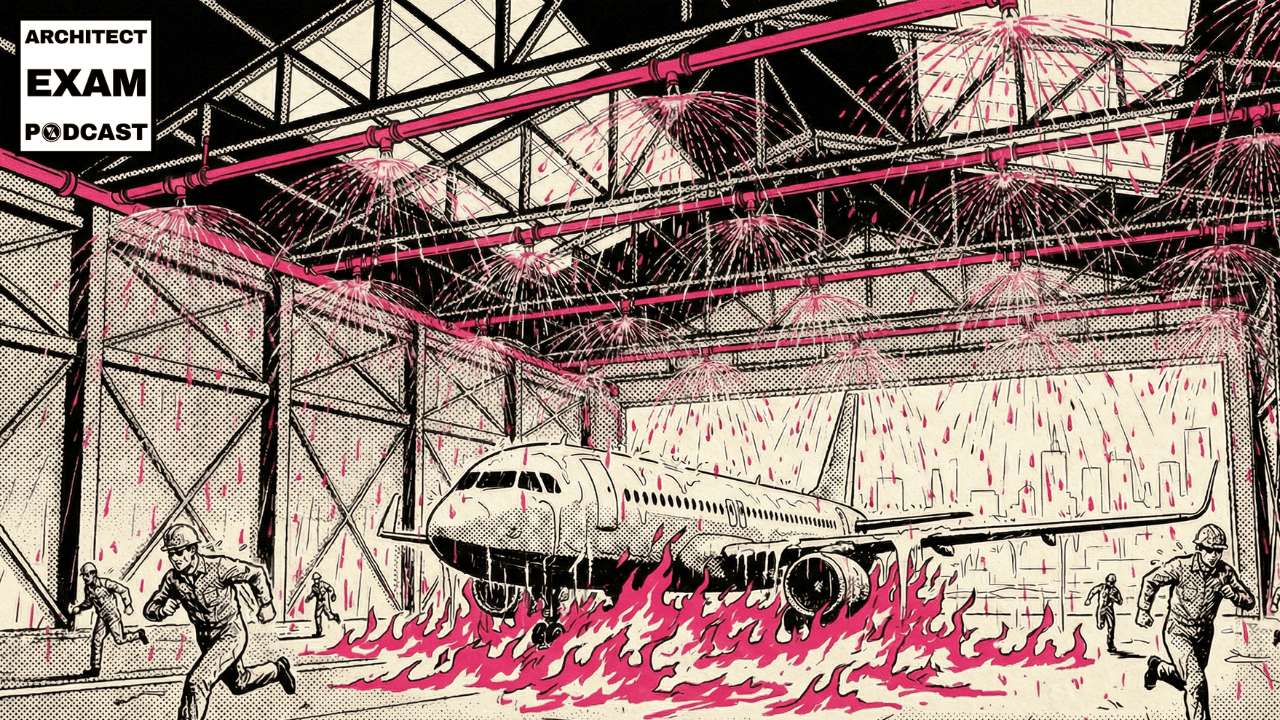

Fire sprinkler systems are one of the most critical life safety systems in any building. This guide breaks down the four main types of sprinkler systems, how they work, when to use each one, and what architects and ARE candidates need to know to make smart design decisions.
This podcast is also available on YouTube, Spotify, and Apple Podcasts
Why Architects Need to Understand Fire Sprinkler Systems
Here’s something that catches a lot of people off guard.
Fire sprinkler system design is the fire protection engineer’s job. Architects don’t design these systems. But architects make dozens of decisions that directly affect how those systems get designed, installed, and maintained.
Think about it. You’re the one deciding:
- How much space to allocate for riser rooms and mechanical closets
- Where the fire department connection (FDC) gets placed on the building exterior
- How deep the ceiling cavity needs to be to fit sprinkler piping above the finished ceiling
- What construction type you’re using, which determines whether sprinklers can buy you more height and area under IBC Chapter 5
You’re also the one sitting in the middle of the coordination between the fire protection engineer, the MEP engineer, the general contractor, and the building department.
If you don’t understand how these systems work, you can’t coordinate effectively. And if you can’t coordinate effectively, things get missed.
This topic shows up across multiple divisions of the Architect Registration Examination (ARE), particularly on PA, PPD, and PDD and we frequently address in our ARE Exam Prep Courses . We’ll touch on specific exam connections throughout this post.
How Fire Sprinkler Systems Actually Work
Let’s start with the basics.
A fire sprinkler system is a network of pipes running throughout a building, connected to a water supply, with sprinkler heads installed at regular intervals along the piping.
When a fire breaks out, the heat from the fire activates the nearest sprinkler head. That head opens up and water flows directly onto the fire.
Here’s the part that Hollywood gets completely wrong.
In almost every movie you’ve ever seen, one sprinkler goes off and suddenly every sprinkler in the building is dumping water everywhere. People are running through hallways getting soaked.
That’s not how it works. In most sprinkler systems, only the heads nearest the fire activate. Each head operates independently based on the heat it’s exposed to. The rest of the building stays dry.
There is one exception to this rule, and we’ll get to that when we talk about deluge systems.
The Basic Components
Every fire sprinkler system has the same core components:
- Water supply: the source feeding the system (municipal water, fire pump, storage tank)
- Fire sprinkler riser: the main vertical pipe that carries water from the water supply up through the building to feed the branch lines on each floor
- Branch lines: the horizontal pipes that distribute water across each floor
- Sprinkler heads: the individual devices that detect heat and discharge water
- Fire department connection (FDC): an exterior connection point where firefighters can pump supplemental water into the system
The FDC is worth calling out specifically because architects are typically responsible for coordinating its location on the building exterior. It needs to be accessible to fire trucks, visible, and properly labeled. This is one of those things that seems minor until the fire marshal flags it during plan review.
The governing standard for fire sprinkler design is NFPA 13, published by the National Fire Protection Association. You don’t need to memorize NFPA 13, but you do need to know it exists and that it’s the standard your fire protection engineer is designing to.
The Four Main Types of Fire Sprinkler Systems
There are four main types of sprinkler systems, and each one exists to solve a specific problem.
The easiest way to think about it is to start with wet pipe as your default, and then ask yourself whether any special conditions require a different system.
Wet Pipe Sprinkler Systems
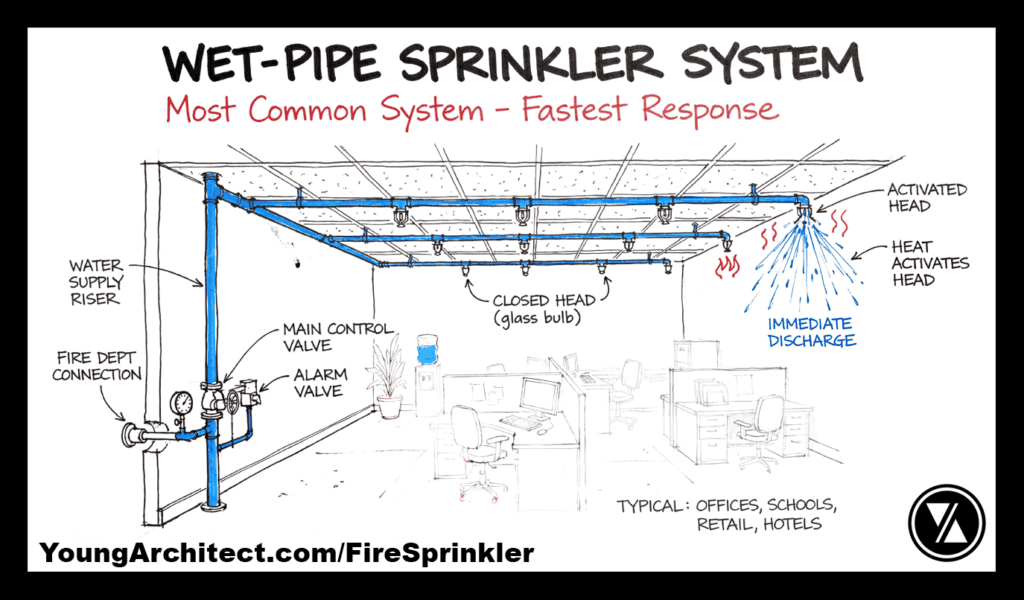
Wet pipe is the most common fire sprinkler system you’ll encounter. And there’s a good reason for that. It’s the simplest, most reliable, and most cost-effective option.
In a wet pipe sprinkler system, the pipes are filled with water at all times. The water is sitting right there, under pressure, ready to go.
When a sprinkler head activates from heat exposure, water flows immediately. There’s no delay, no secondary trigger, no waiting period. Heat hits the head, the head opens, water comes out.
That instant response time is what makes wet pipe the gold standard.
Best for:
- Office buildings
- Residential buildings
- Schools
- Hospitals
- Retail spaces
- Basically any occupied, climate-controlled space
Why it works:
- Fewest moving parts means fewest things that can go wrong
- Fastest response time of any sprinkler system
- Lowest installation cost
- Lowest maintenance cost
- Simplest inspection and testing requirements
The one limitation: wet pipe systems can’t be used in spaces where the pipes might freeze. If the water in those pipes turns to ice, the system doesn’t work. Worse, frozen pipes can burst, causing major water damage.
That’s where dry pipe comes in.
Dry Pipe Sprinkler Systems
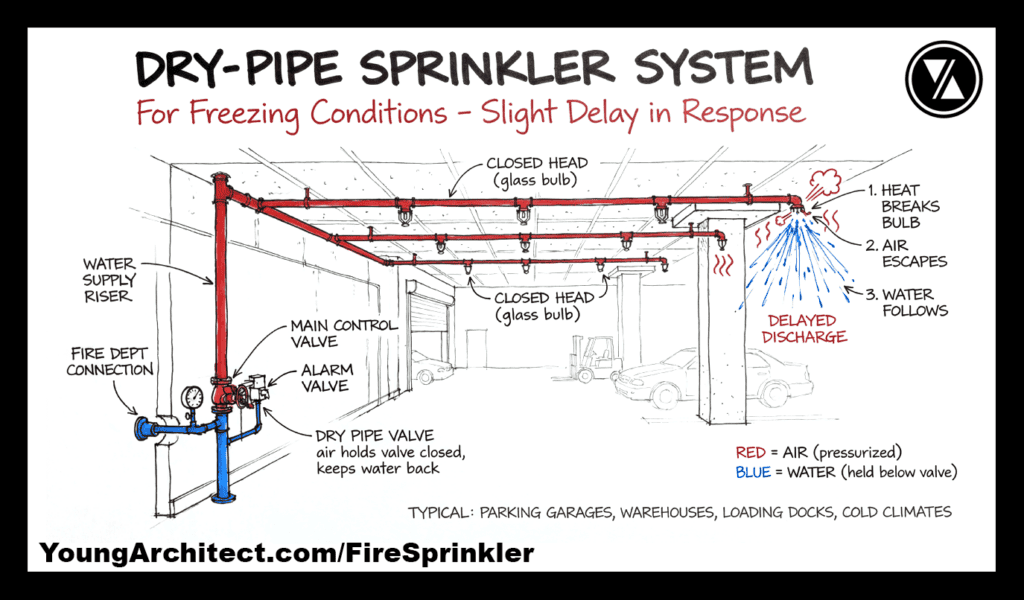
A dry pipe sprinkler system solves one specific problem: freezing temperatures.
Instead of water sitting in the pipes, dry pipe systems are filled with pressurized air or nitrogen. The air holds a valve closed, keeping the water back at the main riser.
When a sprinkler head activates, here’s what happens:
- The head opens and releases the pressurized air
- The pressure drop causes the dry pipe valve to open
- Water flows from the riser into the now-empty pipes
- Water reaches the open head and discharges onto the fire
That sequence creates a built-in delay. It can take up to 60 seconds for water to travel through the piping and reach the activated head. That’s a meaningful difference compared to wet pipe, where water is right there instantly.
Best for:
- Unheated parking garages
- Loading docks
- Unheated warehouses
- Attics and crawl spaces exposed to freezing temperatures
- Exterior canopies and covered walkways
- Cold storage facilities
Important detail for architects: the dry pipe valve and riser room must be in a heated space. Even though the branch piping runs through unheated areas, the valve itself needs to stay above freezing to function properly. This affects your mechanical room planning and fire sprinkler riser room placement.
Pre-Action Sprinkler Systems
Pre-action sprinkler systems exist for spaces where accidental water discharge would be catastrophic.
Think about what happens if a sprinkler head gets bumped by a ladder in a warehouse. In a wet pipe system, water immediately starts flowing. In most spaces, that’s a manageable cleanup.
Now imagine that same accidental activation in a museum full of irreplaceable artwork. Or a server room housing millions of dollars in data infrastructure. Or a hospital operating room during a procedure.
That’s the problem pre-action solves.
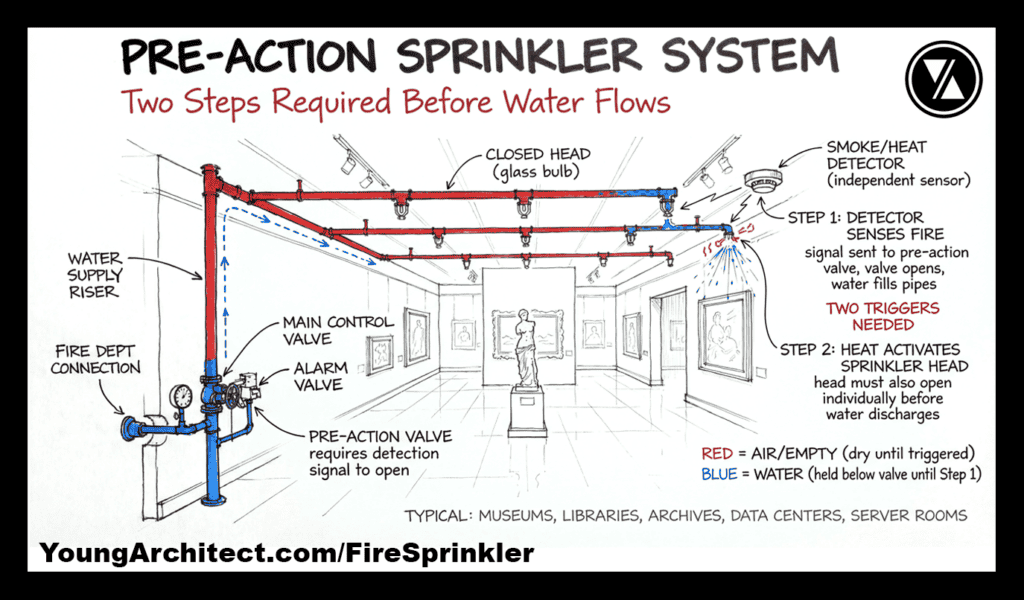
A pre-action sprinkler system requires two separate events before water flows:
- A fire detection system (smoke detectors, heat detectors, or flame detectors) must activate first, which opens the pre-action valve and fills the pipes with water
- Then an individual sprinkler head must activate from heat exposure to actually discharge water
Both triggers have to happen. If a sprinkler head gets accidentally broken, no water flows because the detection system hasn’t confirmed a fire. If the detection system activates but there’s no actual heat at a sprinkler head, the pipes fill with water but nothing discharges.
Best for:
- Museums and art galleries
- Data centers and server rooms
- Archives and rare book collections
- Hospital operating rooms
- Pharmaceutical storage
- Any space where the contents are more valuable than the building itself
The trade-off: pre-action systems are more expensive to install and more complex to maintain. They have more components, more points of potential failure, and require more frequent testing. That added cost is justified when you’re protecting irreplaceable assets, but it doesn’t make sense for a standard office floor.
One of our ARE Boot Camp students had a great moment with this concept. They were working on a museum project and couldn’t figure out why the fire protection engineer specified pre-action for the gallery spaces instead of standard wet pipe. Once they understood the two-step activation and why accidental discharge in a room full of priceless artwork would be a disaster, everything clicked. That’s the kind of understanding that helps you on both the exam and in practice.
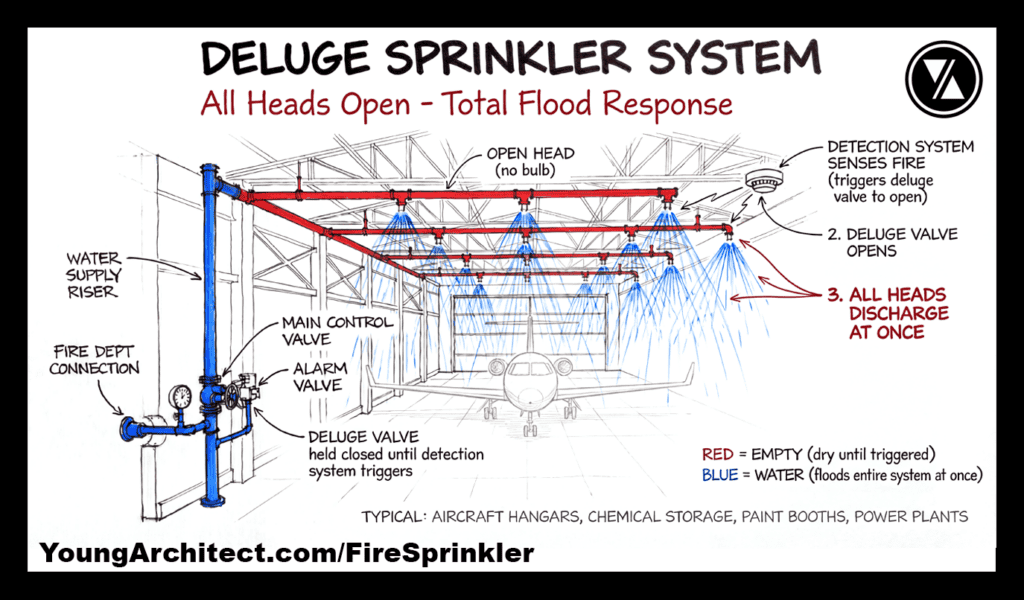
Deluge Sprinkler Systems
Remember when I said Hollywood gets sprinkler systems wrong? That every head going off at once isn’t how it works?
Deluge systems are the exception.
In a deluge sprinkler system, all sprinkler heads are open all the time. There are no fusible links, no glass bulbs, no individual activation mechanism. Every single head is just an open nozzle waiting for water.
The system is controlled by a deluge valve that’s connected to a fire detection system. When the detection system identifies a fire, the valve opens and water flows through every head simultaneously.
This is the most aggressive fire suppression approach. It’s designed for spaces where fire can spread so fast that waiting for individual heads to activate one by one simply isn’t fast enough.
Best for:
- Chemical storage facilities
- Aircraft hangars
- Industrial processing plants
- Power generation facilities
- Spaces storing highly flammable materials
- High-hazard occupancies where rapid fire spread is the primary concern
What architects need to know: deluge systems have the highest water demand of any sprinkler type. That means larger pipe sizes, bigger risers, potentially larger water storage, and possibly a dedicated fire pump. All of that takes up more space in your building. If you’re designing a project that requires deluge, work closely with your fire protection engineer early in schematic design to understand the spatial requirements.
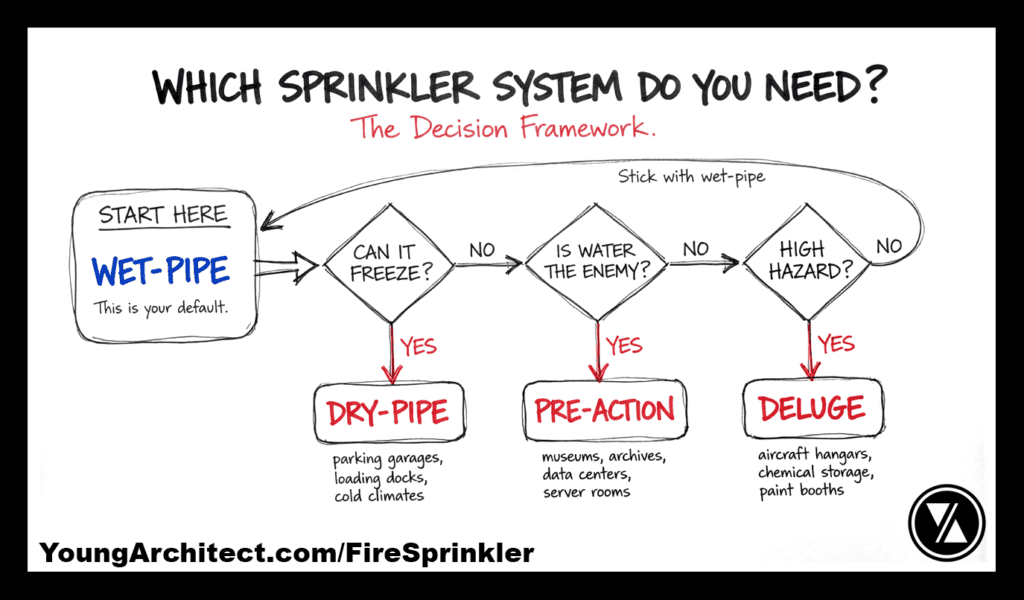
How to Choose the Right Sprinkler System
You don’t need to be a fire protection engineer to understand the basic decision framework. And on the ARE, understanding when and why each system is appropriate matters more than knowing every technical detail about pipe sizing.
Here’s the simplest way to think about it. It’s a process of elimination.
- Step 1: Assume wet pipe. This is your starting point for every space in the building.
- Step 2: Will it freeze? If yes, change that area to dry pipe.
- Step 3: Would accidental water discharge cause catastrophic damage? If yes, change that area to pre-action.
- Step 4: Is the hazard so severe that fire could spread faster than individual heads can respond? If yes, change that area to deluge.
If you get through all four steps and nothing triggered a change, wet pipe is your system.
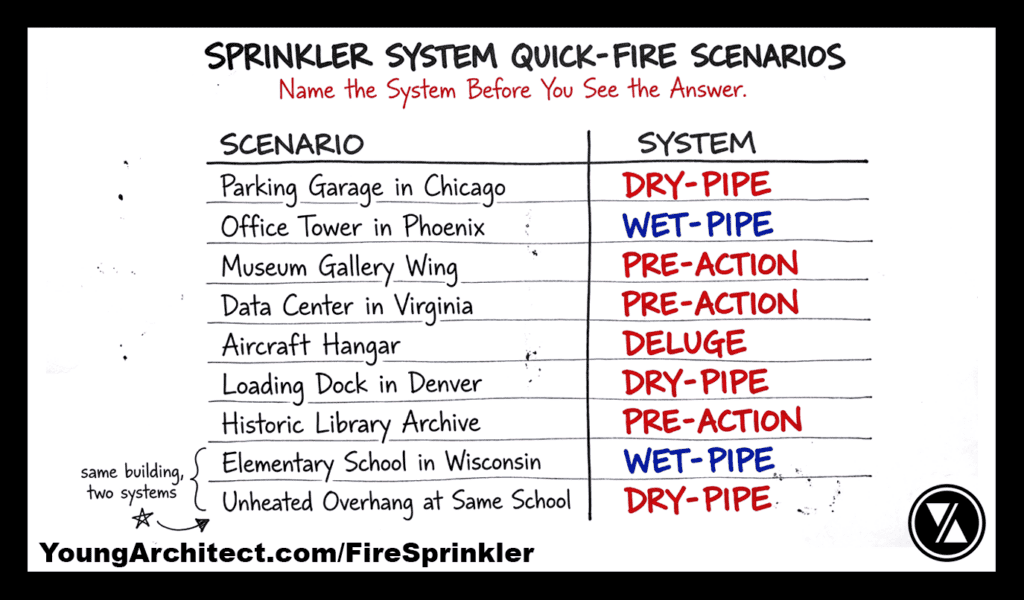
Test yourself with the scenarios above. For each one, run through the decision framework and see if you can name the right system before looking at the answer.
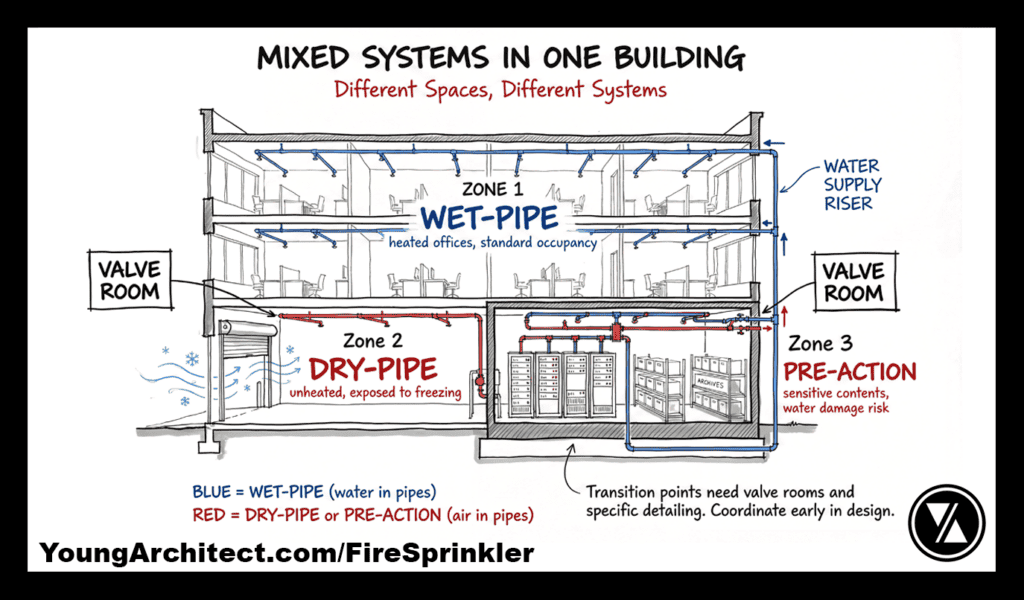
It’s also common to have multiple systems in a single building. A hospital might have wet pipe in patient rooms and corridors, pre-action in the operating suite, and dry pipe in the unheated loading dock. Each area gets the system that matches its specific risk profile.
The architect’s job isn’t to design the sprinkler system. It’s to understand the project conditions well enough to ask the right questions early and give the fire protection engineer the information they need to make good decisions.
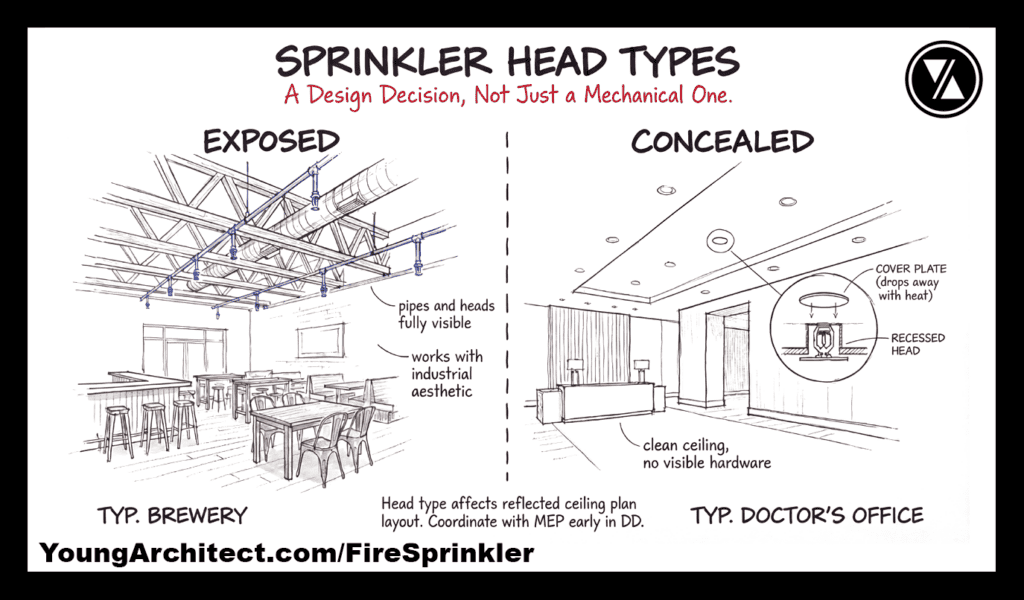
Fire Sprinkler Head Types
Beyond the four system types, architects also need to understand the different types of fire sprinkler heads because they directly affect your ceiling design, reflected ceiling plans, and coordination with lighting and HVAC.
- Pendant heads hang down from the ceiling. Most common type in finished spaces like offices, corridors, and retail. They mount flush or semi-flush with the ceiling grid.
- Upright heads point up from exposed piping. Found in warehouses, mechanical rooms, and any space with exposed structure and no finished ceiling.
- Sidewall heads mount on walls instead of ceilings. Work well in corridors, small rooms, or spaces where ceiling mounting creates coordination problems with ductwork or structural members.
- Concealed sprinkler heads are hidden behind a decorative cover plate that pops off when exposed to heat. Used in finished spaces where the architect or client wants a cleaner ceiling appearance. The cover plate is typically painted to match the ceiling.
Each head type also comes with temperature ratings, indicated by color-coded liquid in the glass bulb or by colored frame arms on fusible link heads.
Why does this matter for architects? Because you’re the one drawing the reflected ceiling plan. You need to coordinate sprinkler head locations with light fixtures, air diffusers, speakers, and any other ceiling-mounted elements. If you don’t account for sprinkler heads in your ceiling layout, the fire protection contractor will put them wherever they need to go, and it won’t be pretty.
Fire Sprinkler Systems on the ARE
Fire sprinkler systems touch multiple divisions of the ARE 5.0, and understanding how they appear on each exam helps you study more effectively.
On the Programming & Analysis (PA) exam, sprinkler systems show up in the context of code research and building analysis. You’re identifying which occupancies require sprinkler systems, understanding hazard classifications, and recognizing how sprinkler requirements affect early project feasibility decisions. This ties directly into building codes and regulations research during the programming phase.
On the Project Planning & Design (PPD) exam, the focus shifts to system selection and building code trade-offs. This is where you need to understand how sprinklers interact with construction types for height and area increases under IBC Chapter 5. Choosing to add a sprinkler system can allow you to build higher, build bigger, or use a less restrictive construction type. Those are significant design decisions.
On the Project Development & Documentation (PDD) exam, you’re dealing with documentation and coordination. That means understanding how sprinkler systems get specified (NFPA 13 references in the specifications, MasterFormat Division 21), how to coordinate riser room locations, ceiling cavity depths, and FDC placement in your construction documents.
The common exam approach is testing whether you know when NOT to use a standard wet pipe system. If you understand the decision framework we covered earlier, you’re in good shape for any sprinkler question the ARE throws at you.
If you’re studying for the technical divisions, our Building Codes 101 course covers how sprinkler systems connect to IBC requirements for construction types, height and area calculations, and fire-rated assemblies. And our ARE 101 study materials cover the full scope of PA, PPD, and PDD exam content.
Frequently Asked Questions About Fire Sprinkler Systems
What is a wet pipe sprinkler system?
A wet pipe sprinkler system keeps the pipes filled with pressurized water at all times. When a sprinkler head activates from heat, water flows immediately. It’s the most common, most reliable, and least expensive type of fire sprinkler system, and it’s the default choice for any occupied, climate-controlled space.
What is a dry pipe sprinkler system?
A dry pipe sprinkler system uses pressurized air or nitrogen in the pipes instead of water. When a sprinkler head activates, the air pressure drops, a valve opens, and water flows into the pipes to reach the fire. Dry pipe systems are designed for spaces exposed to freezing temperatures where a wet sprinkler system would be at risk of frozen or burst pipes.
What is a pre-action sprinkler system?
A pre-action sprinkler system requires two independent events before water discharges. First, a fire detection system must activate to open the pre-action valve and fill the pipes with water. Then an individual sprinkler head must activate from heat to release the water. This two-step process protects against accidental discharge in sensitive spaces like data centers, museums, and operating rooms.
What is a deluge sprinkler system?
A deluge sprinkler system uses open sprinkler heads with no individual activation mechanism. When a fire detection system triggers the deluge valve, water flows through every head simultaneously. Deluge systems are reserved for high-hazard occupancies like chemical storage facilities and aircraft hangars where fire can spread too fast for individual head activation.
What are the different types of fire sprinkler heads?
The four main sprinkler head configurations are pendant (hanging down from the ceiling), upright (pointing up from exposed piping), sidewall (mounted on walls), and concealed (hidden behind a decorative cover plate). Each type serves different architectural conditions, and architects need to coordinate head placement with lighting, HVAC diffusers, and other ceiling elements on the reflected ceiling plan.
What is a concealed sprinkler head?
A concealed sprinkler head is hidden behind a decorative cover plate that sits flush with the finished ceiling. When exposed to heat, the cover plate drops away and the sprinkler head activates. Concealed sprinkler heads are used in finished spaces where the architect or client wants a clean ceiling appearance without visible fire protection hardware.
What is NFPA 13?
NFPA 13 is the standard published by the National Fire Protection Association that governs the design and installation of fire sprinkler systems. It’s the primary code your fire protection engineer designs to. Architects don’t need to memorize NFPA 13, but they need to know it exists and understand that it sets the requirements for sprinkler spacing, pipe sizing, water supply calculations, and system design.
What is a fire sprinkler riser?
A fire sprinkler riser is the main vertical pipe that carries water from the building’s water supply up through the building to feed the sprinkler branch lines on each floor. The riser and its associated valves are typically housed in a dedicated riser room. Architects need to plan for riser room locations, sizing, and access for inspection and maintenance.
What is a fire department connection (FDC)?
A fire department connection is an exterior fitting on the building where firefighters can connect hoses to pump supplemental water into the fire sprinkler system. Architects are typically responsible for coordinating FDC placement on the building exterior, ensuring it’s accessible to fire trucks, visible from the street, and within a reasonable distance of a fire hydrant.
Do all buildings need fire sprinkler systems?
No. Sprinkler requirements depend on several factors including occupancy type, building size, construction type, and number of stories. The IBC outlines specific thresholds that trigger sprinkler requirements. For example, most Assembly occupancies over 12,000 square feet require sprinklers. High-rise buildings (occupied floors above 75 feet) almost always require them regardless of occupancy.
The key takeaway for architects is that sprinkler requirements aren’t one-size-fits-all. You need to check the code for your specific project conditions during the programming phase.
How much does a fire sprinkler system cost?
Costs vary widely based on system type, building size, and complexity. As a general reference, wet pipe systems are the least expensive, typically ranging from $1 to $2 per square foot for straightforward installations. Dry pipe, pre-action, and deluge systems cost more due to additional components and complexity.
These are rough numbers. The actual cost depends on the fire protection engineer’s design, local labor rates, water supply conditions, and building-specific requirements. Architects don’t typically price sprinkler systems directly, but understanding relative costs helps when discussing options with owners during early design phases.
Can fire sprinklers go off accidentally?
It’s rare, but it can happen. The most common causes of accidental discharge are mechanical damage (someone hitting a head with a ladder or equipment), manufacturing defects, or freezing in wet pipe systems installed in unheated spaces.
This is exactly why pre-action systems exist. In spaces where accidental water discharge would cause significant damage, the two-step activation requirement provides a safety net that standard wet pipe doesn’t offer.
How often do fire sprinklers need to be inspected?
NFPA 25 governs the inspection, testing, and maintenance of fire sprinkler systems. The schedule includes visual inspections (monthly and quarterly), flow tests (annually), and full system inspections on longer cycles depending on the system type.
Architects don’t typically handle sprinkler maintenance, but understanding inspection requirements matters when you’re planning access to riser rooms, valve locations, and test connections. If the inspector can’t get to the equipment, that’s a design problem.
What’s the difference between fire sprinklers and other types of fire suppression systems?
Fire sprinkler systems use water as the suppression agent. Types of fire suppression systems is a broader category that includes sprinklers but also covers systems that use clean agents (like FM-200 or Novec 1230), foam, CO2, or dry chemical agents.
Clean agent systems are commonly used in data centers, electrical rooms, and other spaces where water would cause as much damage as the fire itself. These systems are a separate specialty and fall outside the scope of standard NFPA 13 sprinkler design.
Where does the fire department connection (FDC) need to be located?
The FDC needs to be on the building exterior, accessible to fire apparatus, visible from the street, and within a reasonable distance of a fire hydrant. Specific location requirements vary by local jurisdiction, but the general rule is that firefighters need to be able to connect to it quickly without obstacles.
Architects are typically responsible for coordinating FDC placement with the fire protection engineer and the local fire marshal. It’s a small detail that shows up in plan review more often than you’d expect.
Key Takeaways
Fire sprinkler systems don’t have to be complicated. The framework is straightforward once you understand it:
- Wet pipe is the default. Water in the pipes, instant response. Use it everywhere you can.
- Dry pipe solves the freezing problem. Pressurized air holds the water back until a head activates.
- Pre-action adds a safety net. Two triggers required before water flows. Protects spaces where accidental discharge would be devastating.
- Deluge is the most aggressive response. Every head open, every head flowing at once. Reserved for high-hazard occupancies.
The architect’s role isn’t to design the system. It’s to understand these systems well enough to coordinate effectively, make smart decisions about space planning and code compliance, and ask the right questions at the right time.
If you’re preparing for the ARE and want structured guidance on building systems, construction types, and building codes, check out our ARE 101 Course Membership for comprehensive study materials, or join the next ARE Boot Camp cohort for live coaching and accountability.