
Construction Documents Technologist Certification
Master Construction Documents and Pass Your CDT Exam With Confidence
We transform complex construction project delivery into clear, practical knowledge that helps you pass the CDT certification and advance your AECO career.
*Pictures of our actual students
Ace the CDT Exam With Complete Project Delivery Mastery
Our proven approach breaks down construction documents and project delivery into manageable concepts you can apply immediately.
Picture yourself walking into the CDT exam completely confident about roles, responsibilities, and project documentation.
That’s exactly what happens.
CDT Topics You'll Master:
Understanding project delivery methods from design-bid-build to integrated project delivery and CM at risk
Mastering construction documents including drawings, specifications, and CSI MasterFormat organization
Learning roles and responsibilities of owners, architects, contractors, and all project team members
Navigating contract administration with submittals, RFIs, change orders, and closeout procedures
Applying AIA and EJCDC contracts to understand relationships and obligations across project phases
Your Complete CDT Certification Toolkit
Everything you need to master construction project delivery and pass your CDT exam.

Comprehensive Video Lessons
13+ hours of expert instruction covering all 8 CDT Knowledge Domains tested by CSI

Strategic Practice Questions
300+ CDT practice questions with detailed explanations building your understanding progressively

Full-Length Mock Exam
120-question practice exam taken one week before testing to refine your exam-taking ability

Project Delivery Practice Guide Training
Learn to efficiently navigate the PDPG and use it as your primary study resource

Domain-Specific Flashcards
Master 320 CDT flashcards organized by domain to lock in key terminology and definitions

Real-World Application Focus
Not just exam prep - become a better professional who delivers quality work confidently
What Our Students Are Saying About CDT 101
Study smarter, not harder.
CDT Certification Advances Your AEC Career
Whether you’re an architect, engineer, contractor, or construction professional, CDT certification demonstrates comprehensive industry knowledge.
Architects & Designers - Strengthen your understanding of construction delivery and consultant coordination. CDT knowledge complements ARE preparation and makes you more effective in practice.
Contractors & Project Managers – Demonstrate your expertise in project documentation and team roles. CDT certification shows owners and architects you understand the full project lifecycle.
Product Reps & Consultants –Prove your knowledge of construction processes and documentation. CDT credentials help you communicate more effectively with design and construction teams.
Fall 2026 CDT Exam – Key Dates to Remember
August 1, 2026: CDT® 101 is published on The Young Architect Academy. Your access to this course begins on this date.
August 6, 2026: Michael and Emily will host a CDT® webinar. Details Below. this is included with your CDT® 101 enrollment. The recording is shared, if you can’t attend live.
Early August to mid-November: Registration period to sign up for the CDT® exam.
Early-Nov to mid-December: Testing window to take the CDT® exam at a testing center.
The Last Day Available to Take the CDT® Exam: Your CDT® 101 course access expires.
January 2027: CSI releases CDT® exam results.
August 6th 2026: Understanding the CDT and CSI Certifications – Fall 2026 Testing Cycle Webinar: 7:30pm ET/ 6:30pm CT/ 5:30pm MT/ 4:30pm PT. Register for the webinar here!
Meet Your CDT Instructors
Learn from licensed architects who make construction project delivery approachable and accessible.

Emily Hobbs
RA, CDT
A registered Architect in St. Thomas, U.S. Virgin Islands where her passion for environmentally responsible design shines through. Her work focuses on building her community with respect to the islands' unique history, climate, and culture.

Michael Riscica
RA, CSI, CDT
A registered Architect in Florida and Oregon, Michael is the founder of Young Architect Academy and ARE Boot Camp. His passion is demystifying the Architect Registration Exam.
Our Proven CDT Study Method
You don’t just want to study – you want to recall what matters and succeed on test day. That’s why you’ll follow our three-step process:
Learn
Learn by watching easy-to-follow, comprehensive videos that cover the 8 CDT Knowledge Domains.
Recall
Recall information through practice questions and a mock exam before you take the final test.
Refine
Refine your testing ability with feedback from the mock exam, to be unshakable on test day.
What Makes CDT 101 Different
Highly accessible for busy professionals- no in-person meetings required. Study on your computer or phone on your own schedule.
Dynamic teaching approach - real-world scenarios and practical applications, not boring lecture-style presentations.
Extensive practice questions - support recalling important information so you truly learn and succeed on the exam.
Created by registered architects - who have been helping construction professionals pass licensing exams since 2013.
CDT 101 Frequently Asked Questions
We know you have questions. Below we’ve answered everything you need to know about CDT 101, how the exam works, and how to pass it.
Click to jump down to the category that matters most to you:
Understanding the CDT Certification
About the CDT 101 Course
CDT Study Strategy & Preparation
UNDERSTANDING THE CDT CERTIFICATION
What is the CDT® certification?
CDT® stands for Construction Documents Technologist.
It’s a CSI certification created and administered by the Construction Specifications Institute (CSI) that demonstrates your knowledge of construction project delivery, documentation, and team coordination.
Becoming CDT® certified means you understand the entire lifecycle of a construction project from conception through closeout, including roles and responsibilities of all parties involved.
CDT® looks at the big picture of a construction project’s complete lifecycle. It’s also the foundation for other CSI certifications that zoom into specific elements: CCPR™ (Certified Construction Product Representation), CCCA® (Certified Construction Contract Administration), and CCS® (Certified Construction Specifications).
Why Choose CDT Certification
What topics does the CDT® exam cover?
The CDT exam tests your understanding of the complete project lifecycle from conception through the end of the building’s life:
- Concept and Feasibility – When the owner decides they need a building
- Design – Programming, schematic design, design development, and construction documents
- Construction – The actual building process with all its coordination and administration
- Occupancy and Use – How the building functions for years or decades
- End of Life – Eventual renovation, repurposing, or removal
The exam doesn’t just test what YOU do on a project. It tests how everyone works together across every phase.
Studying for the CDT you’ll learn:
- Project delivery methods (design-bid-build, CM at risk, design-build, IPD)
- Construction documents and documentation (drawings, specifications, CSI MasterFormat)
- Roles and responsibilities (owners, architects, engineers, contractors, suppliers)
- Contract administration (submittals, RFIs, change orders, closeout)
- Project phases (programming, design, construction, occupancy)
- General conditions (AIA A201, EJCDC C-700)
CDT exam questions are based on the CSI textbook, the Project Delivery Practice Guide. If it’s not in the PDPG, it won’t be tested.
All this information is broken down and explained across eight different domains on the CDT® exam.
How does CSI organize all the CDT® information?
CSI organizes the exam content into 8 knowledge domains that cover the entire project lifecycle.
This is actually a really helpful system for preparing for the exam.
CSI is known for their ability to beautifully organize lots of complex information, and the domain structure makes studying much more manageable.
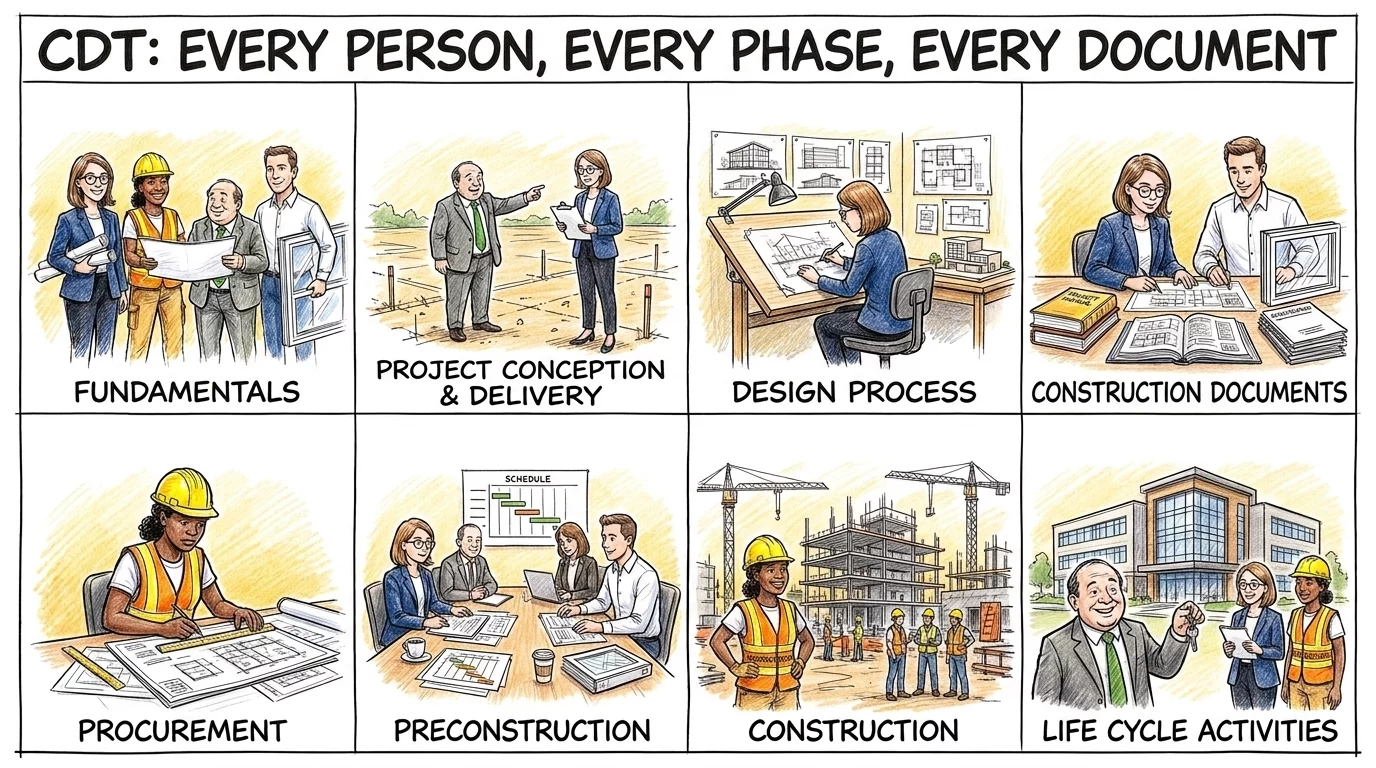
The 8 domains of the CDT are:
- Fundamentals (13%) – Job roles and responsibilities, facility life cycle stages, written and graphic formats, legal implications, and sustainable design approaches.
- Project Conception and Delivery (11%) – Programming and predesign, due diligence, project budgets, insurance, scheduling, site selection, commissioning planning, delivery methods, and team selection.
- Design Process (12%) – Schematic design and design development documentation, design objectives and constraints, cost estimating, life cycle costs, quality assurance/control, and product evaluation.
- Construction Documents (22%) – Drawings, methods of specifying, MasterFormat, SectionFormat, PageFormat, specification language, project manual divisions, and document coordination.
- Procurement (10%) – Competitive bidding, addenda, subcontracting, negotiation, controlling variables, procurement options, pricing, and purchasing.
- Preconstruction (9%) – Notice to proceed, contract documents, preconstruction submittals, permits and regulatory issues, preconstruction meetings, site verification, and mobilization.
- Construction (15%) – Executing work, meetings and documentation, submittals, site visits and inspections, quality implementation, contract modifications, payment, claims and disputes, and project closeout.
- Life Cycle Activities (8%) – Facilities operation and maintenance, resource materials, facility evaluations, and decommissioning.
Each domain represents a percentage of the exam questions. CSI publishes these percentages in the CDT® Handbook.
How is CDT® different from the ARE?
NCARB typically gives everyone plenty of notice before making changes to the ARE.
NCARB announced they’re planning changes to the architect exam for fall 2025. As of October 2025, we’re still waiting to hear more details about what those changes will look like.
Whatever changes come to the architect registration exam, it will be incorporated into your ARE 101 membership.
We’re not creating a separate new product for the new version of the exam. Young Architect Academy is excited to start working on whatever updates NCARB announces.
What are the benefits of CDT® certification?
I'm a construction product representative. How will CDT® help my career?
CDT® makes you a trusted advisor, not just another sales person.
Many product representatives come to the construction industry from outside backgrounds. You might know your products inside and out, but understanding how projects actually work makes all the difference.
Here’s what we’ve learned: Architects and specifiers openly say they prefer working with product reps who have their CDT® certification. Why? Because those reps “speak their language” and understand how projects work from start to finish.
When you have your CDT®, you understand:
- When and how to engage with design teams during different project phases
- How your product fits into the construction documents and specifications
- What architects and engineers need from you to make decisions
- How bidding, substitutions, and value engineering actually work
You’re not just pushing product information. You’re showing that you understand their project, their timeline, and their challenges. That makes you the person they call first.
Is the CDT® easier than the ARE?
We wouldn’t call any of these exams easy. But the CDT® is more straightforward to study for and take than the ARE exams.
ARE questions are complex scenario-based problems testing an architect’s decision-making ability. They give you tons of information and ask what an architect should do.
CDT® questions are more direct. They test whether you understand definitions, processes, and relationships. CDT questions aren’t trying to trick you.
Most people find CDT® significantly less intimidating to study for and take than the ARE exams. It’s still a serious exam that requires preparation, but it’s more manageable.
How long is the CDT® exam?
2 hours for 120 multiple-choice questions.
That gives you about 1 minute per question, which is plenty of time. Most people finish with time to review their answers.
The CDT test is computer-based. You can mark questions for review and come back to them before submitting.
What types of questions are on the CDT® exam?
Mostly multiple-choice questions, including some “select all that apply” and true/false style questions.
CSI writes straightforward questions testing whether you know the material. They’re not trying to confuse you with tricky wording or scenarios.
Example question style:
“Which project delivery method involves the owner contracting separately with the architect and contractor?”
Answer: Design-Bid-Build.
Compare that to ARE style questions with paragraphs of project information before asking what the architect should recommend.
When are CDT® exams offered?
CSI offers CDT® exams twice per year in spring and fall testing windows.
Fall schedule: Typically registration opens in August, with testing in Nov-Dec (check CSI website for exact dates).
Spring schedule: Typically registration opens in January with testing in May-June (check CSI website for exact dates).
You must register during the registration window, but you choose your specific exam date within the testing window.
Here’s what trips people up: You can’t just study for this test and take it whenever you want. You’re on CSI’s schedule. The CDT® is only offered twice a year with specific registration and testing windows.
Registration opens months before the actual testing window. If you want to take the fall exam, you register in August but don’t test until November/December. Plan accordingly and register early to take advantage of early bird pricing.
I'm planning to get my architecture license. Should I do CDT® before or after the ARE?
In a perfect world, we strongly encourage architects to pursue CDT® certification before starting the ARE.
CDT® makes an excellent warm-up for the Architect Registration Exam. The content overlaps significantly, especially with PcM, PjM, and CE. Understanding project delivery, construction documents, and contract administration makes both exams easier.
The architecture licensing exams take most people 700-1500 hours to complete all six divisions. It’s a lengthy, expensive, challenging process. Each ARE division requires months of studying.
CDT® is a much easier win. The questions are more straightforward. Everything you need is in one book (the PDPG). You don’t need to juggle multiple resources or figure out what NCARB might test.
CDT® gives you a different perspective too. ARE exams focus on the architect’s decisions. CDT® teaches you how ALL parties work together, which actually makes you better at answering ARE questions about coordination and project management.
Many of our ARE Boot Camp students take the CDT® while studying for their architect exams and find the overlapping knowledge incredibly valuable.
If you want your architecture license, get started on the ARE. But if you need a confidence boost or want a solid foundation before tackling those challenging ARE divisions, CDT certification is perfect.
How do I register for the CDT® exam?
Visit csiresources.org and create an account.
Click on “Certifications” and find the CDT® registration information. You’ll pay the exam fee directly to CSI (not to Young Architect).
Pro tip: Register early during the early bird window to save money. The exam fee increases as you get closer to the testing window.
After registering, CSI will contact you to schedule your specific exam date at a testing center or for online proctoring. Once registered, you can begin your CDT exam prep with confidence knowing your test date is scheduled.
Should I get more experience before taking the CDT® exam?
No. CDT® has no prerequisites and no experience requirements.
The beautiful thing about CDT® is it’s designed to get everyone on the same page regardless of your background or experience level.
Experience is helpful, sure. But you’ll learn drastically faster studying for CDT® than waiting to gain years of experience on the job.
Here’s the reality: It takes a long time to learn from experience alone. You’re limited to the projects you work on, the delivery methods your firm uses, and the specific roles you’re exposed to.
CDT® gives you the complete picture of how projects work from start to finish, across all delivery methods, from every participant’s perspective. You’ll level up your career much faster with CSI CDT certification than just relying on work experience.
How long should I study for the CDT® exam?
As long as you need to learn the content and confidently show up to take the test and answer the questions.
Most students study for 4-8 weeks, but it depends on your construction experience and familiarity with project delivery.
If you’re already studying for ARE exams (especially PcM, PjM, or CE), you might need less time because there’s significant content overlap.
If you’re new to construction or don’t have much project delivery experience, plan for more study time.
The key is consistency. Studying a little bit every day is more effective for learning the concepts than cramming everything into the week before your exam.
Can I use reference materials during the exam?
No. The CDT® is a closed-book exam.
You cannot use the Project Delivery Practice Guide or any other materials during the test. Everything must come from your knowledge and understanding.
That’s why we focus on understanding concepts, not memorizing the PDPG word-for-word. You need to know the material well enough to answer questions without references.
What happens if I fail the CDT® exam?
You can retake it in the next testing window. Many people don’t pass on their first attempt.
CSI provides a diagnostic report showing which knowledge domains you struggled with. Use that feedback to focus your studying for the retake.
There’s no limit on how many times you can take the CDT® exam. Just register again for the next cycle and keep preparing.
How long will it take to get my CDT® results?
Results typically take 6-8 weeks after the exam window closes.
CSI conducts a thorough scoring analysis after all candidates complete the exam. This includes evaluating individual questions to ensure they performed as expected and setting the passing score with subject matter experts.
You’ll be notified by email when your results are available.
If you don’t pass, CSI provides a diagnostic report showing which knowledge domains you struggled with, so you know exactly where to focus for your retake.
What if I want to skip CDT® and go straight to CCPR/CCCA/CCS?
That doesn’t really make sense, and here’s why:
CDT®’s power is that it gets everyone on the same page with the ENTIRE project lifecycle. It’s the foundation.
The other CSI certifications (CCPR™ for product representatives, CCCA® for contract administrators, CCS® for specifiers) zoom into specific elements that were already covered in CDT®, but go much deeper into those specialized areas.
Think of it this way: CDT® covers the complete project from concept to closeout. Then the advanced certifications dive deeper into specific phases or roles within that framework.
Starting with this foundational construction certification makes those advanced certifications much easier because you already understand how your specialized role fits into the bigger picture.
What's the difference between CDT® and CSI Member or AIA Associate after my name?
CDT® is a certification. CSI and AIA memberships are not.
CDT® certification proves competency through rigorous testing. You studied the material, passed the exam, and demonstrated your knowledge.
CSI Member and AIA Associate after your name simply show you paid membership dues to professional organizations. These memberships show commitment to the community and professional involvement, but they don’t prove skill competency.
Not all credentials are equal:
- Some prove you have knowledge (certifications like CDT®)
- Others show you belong to the club (memberships like CSI, AIA Associate)
Both have value, but they serve different purposes. Memberships connect you with communities and provide resources. Certifications prove you actually know your craft.
When someone sees CDT® after your name, they know you passed a comprehensive exam demonstrating your understanding of construction project delivery. That’s very different from paying annual membership dues.
ABOUT THE CDT 101 COURSE
What is CDT® 101?
CDT® 101 is a self-paced CDT exam prep course designed to help you pass the Construction Documents Technologist (CDT®) certification exam offered by the Construction Specifications Institute (CSI).
The course includes 12+ hours of video instruction covering all 8 CDT® Knowledge Domains, 300+ practice questions with detailed explanations, a 120-question mock exam, and training on how to efficiently use the Project Delivery Practice Guide (PDPG).
You’ll learn construction project delivery from start to finish, understanding roles, responsibilities, documentation, and contract administration across all project phases.
Is CDT® 101 part of the ARE 101 membership or ARE Bootcamp?
No.
CDT® 101 is a completely separate course for a completely different exam.
The CSI certification is not part of the Architect Registration Exam (ARE). It’s administered by the Construction Specifications Institute (CSI), not NCARB.
CDT® 101 is a one-time purchase ($249) that gives you access through the end of the testing cycle. It’s not included in the ARE 101 monthly membership.
How much does CDT® 101 cost?
$249 for access through the end of the testing cycle.
That’s a one-time payment. There are no recurring charges or hidden fees.
For comparison, ARE Boot Camp costs $1,300 and is a 10-week intensive coaching program with live calls and personalized support. CDT® 101 is self-paced without live coaching, which keeps the price accessible.
I'm looking for the CDT® Boot Camp?
You may be confused.
We don’t offer a CDT® Boot Camp, and we never have.
For the Architect exam we are known for our popular ARE Boot Camp (a 10-week intensive coaching program for the Architect exam that costs $1,300).
We offer CDT® 101 (a self-paced online course for the CDT® exam that costs $199).
These are two completely different products for two completely different exams. CDT® 101 is self-paced. You study on your own schedule. There are no live coaching calls or weekly meetings.
Honestly, the CDT is a very manageable exam to study for and take. You just need to make time for it and show up and do the work. It doesn’t need a Boot Camp program like the ARE does.
Who is CDT® 101 for?
Anyone working in any aspect of architecture, engineering, or construction who wants to demonstrate comprehensive industry knowledge.
That includes:
- Architects and designers
- Engineers and consultants
- Contractors and project managers
- Construction professionals
- Product representatives and suppliers
- Recent graduates entering the industry
- Career changers
- Lawyers, accountants, real estate professionals, or any similar supporting roles in the AECO industry
The CDT® certification is for everyone in the building industry, not just architects. You don’t need to be licensed or even pursuing licensure to benefit from CSI certification.
Why should I get CDT® certified?
Because it will make you a better professional.
The information you learn studying for the CDT® exam isn’t just for passing a test. This is knowledge you’ll apply to every single project you work on for the rest of your career.
You’ll become more confident at work. Many students tell us that while studying for the CDT®, they started recognizing concepts popping up in their day-to-day work. It made them more confident and allowed them to speak up more on job sites and in the office.
The confidence boost from studying often comes before you even take the exam. You’ll understand project processes better, communicate more effectively with different disciplines, and contribute to projects in new ways.
When your boss asks “How have you developed yourself professionally?” you’ll have tangible evidence. CDT® certification demonstrates your knowledge and competency with construction project delivery.
This isn’t just about adding letters after your name. It’s about becoming someone who truly understands how successful projects get delivered. Focus on being successful in your career – passing the exam is just a byproduct of that larger mindset.
CDT® is universal knowledge that applies to every project. Unlike specialized certifications like LEED or WELL that focus on specific building types or systems, CDT® covers the fundamentals that show up on every single design and construction project you’ll ever work on.
This is baseline knowledge for the entire industry, not a niche specialty.
What's included in CDT® 101?
12+ hours of expert video instruction covering all 8 CSI Knowledge Domains tested on the CDT® exam.
You’ll get complete coverage of project delivery methods, construction documents, roles and responsibilities, contract administration, and project phases from programming through closeout.
Plus:
- 300+ CDT practice questions with detailed explanations
- 120-question full-length mock exam taken one week before testing
- Project Delivery Practice Guide (PDPG) navigation training
- Access via computer and mobile so you can study anywhere
Our practice questions aren’t just for testing yourself. They’re actually a teaching tool. You learn by reading the question, thinking through it, and choosing the right answer.
If you get it wrong, you correct your understanding in the moment. This active recall method helps the information stick way better than just passively reading the PDPG.
How long do I have access to CDT® 101?
You have access through the end of the testing cycle you purchase for.
For Fall 2025, that means your access continues through December 12, 2025 (the day after the testing window closes).
If you buy during early registration in August, you could have 4+ months of access. If you buy closer to the testing window, you’ll have less time but still enough to prepare thoroughly.
Your access ends after the testing cycle expires. CDT® 101 is sold per cycle, not as an ongoing membership.
Can I keep access after the testing window ends?
No. CDT® 101 access expires when the testing cycle ends.
Can I cancel my CDT® 101 purchase?
CDT® 101 is a one-time purchase, not a recurring membership like our ARE courses.
Once you purchase, you have access through the testing window expiration date. There are no recurring charges to cancel.
If you have concerns about the course, contact us at support@youngarchitect.com.
Is CDT® 101 affiliated with CSI?
No. CDT® 101 was created by Young Architect Academy and is not affiliated, endorsed, or sponsored by the Construction Specifications Institute (CSI).
Emily Hobbs and Michael Riscica created this course based on their experience passing the CDT® exam and helping thousands of construction professionals pass licensing exams since 2013.
CSI administers the CSI certification exam. We provide the preparation course to help you study for it.
When you pass the CDT® exam, you’ll receive a digital badge from Credly that you can display on LinkedIn, your email signature, and your resume. You’ll also receive a complimentary paper certificate. These credentials make it easy to show employers and clients that you’re CDT® certified.
Do I need the Project Delivery Practice Guide (PDPG)?
Yes, absolutely. The PDPG is CSI’s official reference manual and your primary study resource.
Think of it as your textbook and primary CDT study guide. The CDT® exam questions are based directly on PDPG content.
CDT® 101 is not a replacement for studying the PDPG. The CDT® exam tests your knowledge of the Project Delivery Practice Guide, not our course content.
The purpose of CDT® 101 is to teach you the concepts being tested so you get more value out of studying the PDPG. We show you what matters, how to navigate the book efficiently, and help you understand the material rather than just memorizing hundreds of pages.
You can purchase the PDPG through CSI’s website. Make sure you get the most current edition (3rd edition as of 2025).
Can I use CDT® 101 on my phone?
Yes. We actually encourage you to use the course on your phone.
After you sign up, you can log in through the browser on your phone and everything works smoothly. We built the course platform to be fully mobile-responsive, so it adapts perfectly to your screen size whether you’re on a phone, tablet, or computer.
We used to have a dedicated app, but we decided to invest in making our website work better on mobile devices instead. This way you don’t need to download anything – just log in and study.
Watch videos during your commute and review practice questions during lunch. Study wherever works best for you.
CDT STUDY STRATEGY & PREPARATION
When should I start studying for the CDT® exam?
Start as soon as you register for the exam. Time is your biggest advantage.
You don’t have to go 100 miles an hour on day one. Even baby steps for the first couple weeks help your brain wrap around the material.
Think of it like getting into shape. If you want to run a marathon, you don’t jump off the couch and run 18 miles. You’ll get hurt. You do a little bit at a time, and over time it gets easier.
Focus on being consistent. Slow and steady wins. If you start early and do something every single day, even just a little bit, it’s going to be so much easier when you get to test day.
How should I use the Project Delivery Practice Guide?
Use the PDPG as your primary CDT study guide and reference guide.
CDT 101 is a supplemental resource designed to make learning the concepts inside the PDPG much easier and set you up for success when studying the PDPG.
Good news: if it’s not in the PDPG, you’re not going to be tested on it. Everything on the CDT® exam comes from this book.
The way the book is written, it’s organized by domains (essentially chapters) that follow the sequence of a project from start to finish. It starts with foundational knowledge, then does a deep dive on project delivery methods, then ramps up into all the roles and responsibilities through successful project completion.
CSI has their own vocabulary and terms you’ll see throughout. Use the PDPG as a dictionary to look up definitions. The glossary is your friend.
Our course teaches you how to navigate the PDPG efficiently rather than trying to memorize hundreds of pages. We show you what matters and where to find information quickly.
Should I read the entire PDPG cover to cover?
Yes, but strategically.
Going through CDT 101 is going to give you a lot of clarity about how to study the PDPG.
Don’t just passively read. Engage with the material. Mark what’s unfamiliar. Focus extra attention on concepts that are new to you or contradict what you thought you knew.
How do I know what to focus on when studying?
If you already know something, skim and move on. If it’s new, dig deeper.
You might be familiar with a lot of this information from work. In that case, make sure your existing knowledge aligns with what is being taught. If so, you can skim and review what’s already familiar and focus your energy on new concepts.
For instance, the PDPG goes into depth on definitions and responsibilities of each person on a project. You might already know basic roles and who hires whom. Review that, then move on.
But here’s the key: forget what you think you know.
The way things are done in your office every day is not always the right answer on the CDT® exam. Learning the proper way things are done, the CSI way, is how you’re going to be tested.
Study how CSI defines and breaks down concepts, even if you think you already understand them.
What if I don't have construction experience?
You don’t need experience to understand CDT® concepts. We explain everything from the ground up.
In fact, sometimes having less experience helps because you don’t have assumptions about how things work based on limited exposure to one type of project or delivery method.
Many recent graduates and career changers use this course successfully. The PDPG is written for anyone in the building industry, not just experienced construction professionals.
The key is connecting concepts to real projects. Even if you haven’t worked on projects yet, visualize how the information applies to actual buildings being designed and constructed.
How important are practice questions?
Practice questions are critical. They help you recall information so you truly learn it.
We’ve included 300+ CDT practice questions in CDT 101 specifically to support recalling important information. This isn’t just about memorizing, it’s about understanding.
Our questions are deliberately challenging, even harder than the actual exam. We wrote them like ARE-style scenario questions to force you to use your brain and really understand the content.
When you take the real CDT® exam, you’ll think “Oh my gosh, these questions are so straightforward” compared to what you practiced.
Take the mock exam one week before your test date. That 120-question practice exam helps you refine your testing ability and build confidence going into test day.
Should I memorize contracts like the AIA A201?
No.
We don’t recommend “memorizing” contracts, that just sounds exhausting.
Instead, focus on learning the concepts and the theory of what the contract says, so it could be applied to situations and scenarios.
Thinking about it this way feels a lot more manageable.
CDT® is not a huge contracts exam like the ARE.
You need a broad understanding of what contracts are and why they exist, not memorization of specific clauses.
Most importantly, the CDT® focuses on General Conditions (which CSI calls “Conditions of the Contract”). You need to understand what’s in the A201 and EJCDC C-700, how they’re different from other documents, and why projects need them.
Focus on the big picture: What do these contracts govern? How do they define relationships? When would you modify them versus other project documents?
You don’t need to know specific article numbers or quote contract language.
How do I visualize applying this information?
Try to connect every concept to real projects.
The one challenge with the PDPG is it talks about project delivery almost as if it’s in a vacuum. It gives beautiful definitions but doesn’t always provide real-life scenarios.
Always ask yourself: how does this information apply to actual projects?
For example, to properly understand responsibilities between owner, architect, and contractor with RFIs, construction change directives, and change orders, you need a situation and scenario. When’s the timing? Who initiates? Who responds?
The more you can reconnect material to real projects, the easier the information sticks.
That’s why our course includes real-world scenarios and practical applications, not just lecture-style presentations of definitions.
What if I'm studying for ARE exams at the same time?
CDT® actually helps your architect registration exam preparation.
There’s significant content overlap, especially with PcM, PjM, CE, PDD, and PPD. Understanding project delivery, construction documents, and contract administration once makes both CDT® and ARE exams easier.
Many ARE Boot Camp students pass CDT® with just a few weeks of focused study because they’re already familiar with many concepts.
The CDT® gives you a different perspective too. ARE exams focus on the architect’s decisions. CDT® teaches you how ALL parties work together, which makes you better at answering ARE questions about coordination and project management.
We use the PDPG as one of the required textbooks in ARE Boot Camp for PcM, PjM, and CE. It does a better job explaining construction administration than many other resources.
How can I make studying more enjoyable?
Connect it to becoming a better professional, not just passing a test.
Once you get past the hurdles of finding time to study, the information you’re learning is absolutely fascinating. This knowledge helps you succeed in your career.
What you learn earning CSI certification comes up on every single project you’ll ever work on. This isn’t like some certifications where you might never use the knowledge. This is baseline information for the entire industry.
The sooner you convince yourself this is actually fun and valuable, that you NEED this knowledge to succeed, the easier it becomes to show up and do the work.
Use this as an opportunity to become a better professional, not just pass a test. The information will help you do your job better.
Will studying CDT® help me at my actual job?
Absolutely. You’ll start seeing this information everywhere at work.
Many people tell us that while studying for CDT®, they started recognizing concepts popping up in their day-to-day work. It made them more confident and allowed them to speak up more on job sites and in the office.
The confidence boost from studying often comes before you even take the exam. You’ll understand project processes better, communicate more effectively with different disciplines, and contribute to projects in new ways.
You’re not just studying for a test. You’re building knowledge that makes you a more valuable construction professional in your role, regardless of what that role is.
What's the biggest mistake people make studying for CDT®?
Waiting too long to start or thinking they can cram everything in at the last minute.
This information layers on top of itself. You need time for concepts to sink in and connect to each other.
Another mistake is only memorizing definitions without understanding how concepts apply to projects. You need both the what and the why.
Also, some people rely too heavily on old habits from their office instead of learning how CSI defines proper processes. The CDT® tests best practices, not how your specific firm happens to do things.
Start early. Study consistently. Focus on understanding, not just memorizing.
How do I stay motivated while studying?
Remember why this matters for your career.
Architecture is a competitive and rapidly changing profession. Why not get the advantage construction certification can give you at any stage of your career?
CDT® certification demonstrates competency in construction project delivery. It shows owners, architects, contractors, and consultants that you understand the full project lifecycle.
When your boss asks “How have you developed yourself professionally?” you’ll have tangible evidence. When you’re working on a project, you’ll speak with confidence about processes and responsibilities.
Focus on being successful in your career, passing the exam is a byproduct of that larger mindset. That makes showing up to study so much easier than treating it like an annoying chore.